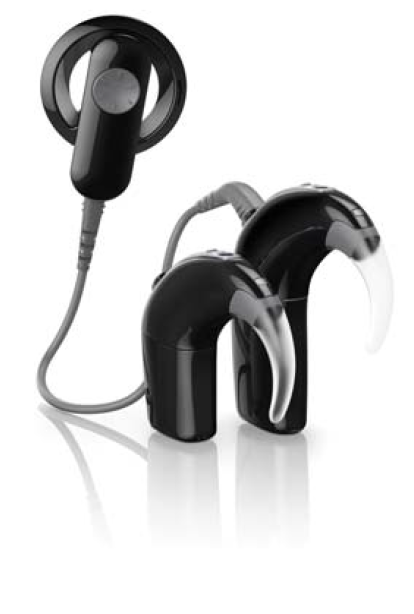
MED-EL recently rolled out the RONDO processor. Cochlear has just received FDA approval for the Nucleus 6. And AB is awaiting FDA approval for the Naída CI. Why isn’t the new hardware available as soon as it has been approved?
Two executives from Advanced Bionics offer some insight into the process of launching a new product, including the risks and challenges of getting the product to market as soon as possible.
CochlearImplantHELP.com and Nammu swim hats are pleased to offer a 25% discount on Nammu swim hats until August 15th, 2013. Use discount code ‘cochlearimplantHELP’ when you place your order with Nammu.
Recent advances in cochlear implants have enabled some of us to go swimming with our ears on. Advanced Bionics’ Neptune is the only waterproof processor. But not everybody has one, or is in a position to get one.
Cochlear’s Aqua Accessory is a single-use plastic bag designed for the Nucleus 5 processor. Usable for up to one or two hours, depending on your location, “Your Nucleus Global Limited Warranty will not be void in circumstances where the Aqua Accessory is used in water with a CP800 series sound processor only, in accordance with the Aqua Accessory instructions.”
The Aqua Accessory’s position on the ear makes sense for a BTE processor, but may not be the best location for water activities. Because it is a big flap extending behind your ear, it can come off when you jump in the water. It’s certainly a good idea to use a tether at a minimum, and a swim cap and goggles are even better.
The aLOKSAK bag from LOKSAK is hermetic and certified waterproof up to 200 feet (60 meters) depth. You can put your processor in a reusable aLOKSAK bag, and tuck the bag under a Nammu swim hat. Dive, jump, surf, and splash all day long!
Because this solution doesn’t come from the cochlear implant manufacturers, use it at your own risk. However, we have tested this in lots of situations, including on the incredible FlowRider.
Surf until you wipe out, then 35,000 gallons of water per minute carries you to the top of the ramp and over the lip, where you hit the padded wall. And the Nammu swim hat never comes off!
The aLOKSAK/Nammu combination works with any BTE processor, and also MED-EL’s one-piece RONDO. The smallest bag, aLOK3-3X6, is large enough to hold any recent BTE processor and headpiece.
The Nucleus® 6 System is our most advanced hearing solution to date, designed with a clear purpose – to help you simply enjoy smarter hearing.
The announcement doesn’t say when the processor will be available. It is awaiting FDA approval in the US. Key features of the processor include combined electro-acoustic stimulation, and wireless connectivity (when the accessories become available).
If you are in the US or Canada and receive an implant from Cochlear, you can trade in the Nucleus 5 processor for the new processor when it becomes available. Details here.
This is an April Fool’s post. Cochlear Implant HELP strives to provide timely and accurate information. So as not to mislead our readers, we now identify April Fool’s posts that mention specific cochlear implant manufacturers with this header. Our posts often hint at features that would exceed the hopes of many of our readers by far. While the posts are intended in jest, they do reflect some of the wishes of the community, and manufacturers might benefit from accepting these as inputs for longer-range product possibilities.
Cochlear leaps ahead in the fully-implantable technology race.
Cochlear has submitted a patent application to the US Patent and Trademark Office for a fully-implantable cochlear implant. While there are already many patents by all manufacturers for these devices, this one seems to go way beyond the state of the art.
The biggest advance seems to be in the surgical technique. Because the electronics are on a flexible ‘board’ they can be rolled into a cylindrical shape. Starting with the electrode array, the entire assembly is inserted through the nostril. Conventional arthroscopic instruments are inserted through the opposite nostril, and also through a small incision in the ear drum. There is no shaving of hair, no incisions other than the ear drum, and no waiting period before activation.
While the surgical technique is not claimed in the patent, it seems the surgery may be performed with a mild sedative and a local anesthetic. Because there is no need for swelling to dissipate or incisions to heal, the implant may be activated on the day of the surgery.
To charge the battery (or super capacitor) just keep a charging box next to your bed, and the power is transmitted wirelessly while you sleep.
Key points in the claims:
The electronics are on a flexible substrate, which may be rolled up for nasal insertion.
Use of a supercapacitor instead of a battery.
Insertion of the electrode array through the Eustachian Tube.
Unrolling the substrate so it lies flat in a sinus cavity.

 MED-EL recently rolled out the RONDO processor. Cochlear has just received FDA approval for the Nucleus 6. And AB is awaiting FDA approval for the Naída CI. Why isn’t the new hardware available as soon as it has been approved?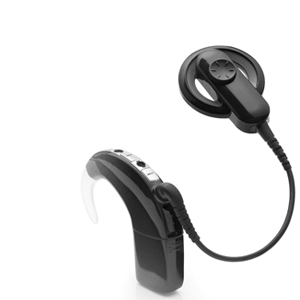



 cochlear implant HELP