
If you are in the US or Canada and receive an implant from Cochlear, you can trade in the Nucleus 5 processor for the new processor when it becomes available. Details here.
Tag Archives: cochlear implant
Sonova (Advanced Bionics) Investor Presentation April 2013
Click to view the Sonova Holdings, parent company of Advanced Bionics investor presentation
Points of interest for Advanced Bionics users include:
- Product pipeline on page 9. The bottom row shows that the low-power wireless communication system in the upcoming Naida CI Q70 will transition to digital in future processors. The new technology is described on pages 16-19.
- The Advanced Bionics product pipeline is on page 27. For 2013 we see the HiFocus Mid-Scala array, the HiRes 90k Advantage, and the Naida CI Q70 processor. New arrays, implants, and processors are scheduled roughly every year! This year’s products are described on pages 28-31.
- HiRes Optima, the low-power extended battery life strategy, is mentioned on page 32. The strategy is compatible with Harmony and Neptune processors as well as the Naida CI.
William Demant Acquires Neurelec
In the latest move in the cochlear implant industry, William Demant Holding Group has acquired French cochlear implant manufacturer Neurelec.
William Demant is the parent company of Oticon, known for hearing aids, and more recently, bone-anchored hearing aids.
Fully Implantable CI Patent Application from Cochlear
This is an April Fool’s post. Cochlear Implant HELP strives to provide timely and accurate information. So as not to mislead our readers, we now identify April Fool’s posts that mention specific cochlear implant manufacturers with this header. Our posts often hint at features that would exceed the hopes of many of our readers by far. While the posts are intended in jest, they do reflect some of the wishes of the community, and manufacturers might benefit from accepting these as inputs for longer-range product possibilities.
Cochlear leaps ahead in the fully-implantable technology race.
Cochlear has submitted a patent application to the US Patent and Trademark Office for a fully-implantable cochlear implant. While there are already many patents by all manufacturers for these devices, this one seems to go way beyond the state of the art.
The biggest advance seems to be in the surgical technique. Because the electronics are on a flexible ‘board’ they can be rolled into a cylindrical shape. Starting with the electrode array, the entire assembly is inserted through the nostril. Conventional arthroscopic instruments are inserted through the opposite nostril, and also through a small incision in the ear drum. There is no shaving of hair, no incisions other than the ear drum, and no waiting period before activation.
While the surgical technique is not claimed in the patent, it seems the surgery may be performed with a mild sedative and a local anesthetic. Because there is no need for swelling to dissipate or incisions to heal, the implant may be activated on the day of the surgery.
To charge the battery (or super capacitor) just keep a charging box next to your bed, and the power is transmitted wirelessly while you sleep.
Key points in the claims:
- The electronics are on a flexible substrate, which may be rolled up for nasal insertion.
- Use of a supercapacitor instead of a battery.
- Insertion of the electrode array through the Eustachian Tube.
- Unrolling the substrate so it lies flat in a sinus cavity.
- Wireless radio-frequency charging.
Read the full patent application here.
Sinn Féin Insists Irish Government Provide Bilateral Implants for Children
Sinn Féin has taken a firm stance requesting that the Irish government fund bilateral implants for children. Read the statement here.
New Electrode Array Technology Development

Pamela Bhatti, Ph.D., leads a team of scientists and engineers who are working on a new device that could dramatically improve sound resolution for deaf individuals who opt for cochlear implants. The researchers believe the new array could help users overcome the limitations in language perception that plague contemporary implants.
Read more here.
“We are hopeful”: Cochlear implants campaign gets boost
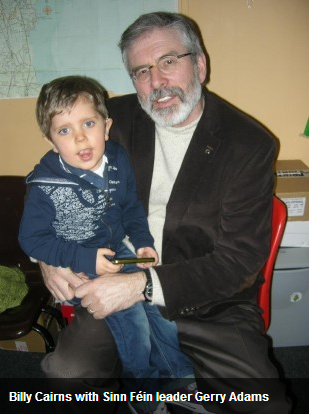
THE CAMPAIGN IN IRELAND RUN BY parents to have children fitted with two cochlear implants instead of the standard one has received a new boost.
Sinn Féin leader Gerry Adams is among those who has pledged his support to the Happy New Ear campaign, and met with Deanna Cairns and her son Billy (4) last week after he brought up the issue in the Dáil.
Interview with Author Arlene Romoff
 The American Academy of Audiology interviewed Arlene Romoff about bilateral cochlear implants and implant failures. Read more!
First Retinal Implant to Receive FDA Approval
 The Food and Drug Administration on Thursday approved the first treatment to give limited vision to people who are blind, involving a technology called the “artificial retina.”
With it, people with certain types of blindness can detect crosswalks on the street, burners on a stove, the presence of people or cars, and sometimes even oversized numbers or letters.
Developed over 20 years by Dr. Mark S. Humayun, an ophthalmologist and biomedical engineer at the University of Southern California’s Doheny Retinal Institute, the artificial retina was inspired by cochlear implants for the deaf.
Read more on the New York Times.
Cochlear CEO Chris Roberts on Navigating a Disaster

Chris Roberts
The CEO of Cochlear describes his well-received response to the CI500 series recall. Read more in the Australian business journal Leading Company.
 cochlear implant HELP