Text-to-911 Calls (USA)

Call if you can

In areas where text-to-911 is available, you may see a graphic such as this.

How to contact 911

If you are deaf, hard of hearing or speech disabled and using a wireless phone or other type of mobile device, make sure to do the following in an emergency::

  • Always contact 911 by making a voice call, if you can.
  • If you are deaf, hard of hearing or speech disabled, and text-to-911 is not available, use a TTY or a telecommunications relay service, if possible.
  • Remember – in most cases now, you cannot reach 911 by sending a text message.

In some circumstances, you may be able to reach emergency services in the United States by sending a text from your cell phone.  This capability is only available in some areas.  If at all possible, you should make a voice call.  If you cannot make a voice call, a relay service or tty is the next choice.

Note that text-to-911 isn’t just for people who have difficulty using the telephone.  Texting may be quieter than a voice call, which may help in some unsafe situations.

Here are some quick facts and FAQs.

More information, including a signed and captioned video, is available here.

The FCC maintains an Excel spreadsheet of locations where text-to-911 is available, updated monthly.

The FCC has adopted an order requiring wireless carriers and other text services to provide text-to-911 service within 6 months of receiving a request.  The request must come from the emergency call center.

Applying for Social Security Benefits

Deanna Power

Deanna Power, Community Outreach Manager for Social Security Disability Help , has contributed a page to help you learn about Social Security Disability Insurance (SSDI) and Supplemental Security Income (SSI) in the United States.  Find out if you qualify at Applying for Social Security Benefits.

How Do Implanted Children Learn to Talk?

The latest issue of EXPLORE magazine is now available! Published by hearing implant manufacturer MED-EL, this international publication provides an in-depth look at key hearing loss-related topics.  EXPLORE KIDS was just released and is available for free (print or download) at www.medel.com/explore.  One sample article, How Implanted Children Learn to Talk, is republished here with permission for your convenience.
therapy.png

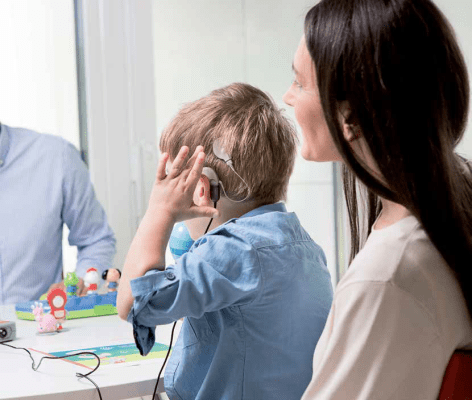
MED-EL Rehabilitation Manager, Ingrid Steyns,explains how children with cochlear implants can learn to speak as well as their peers

In what circumstances are cochlear implants (CIs) suitable for a child? 

CIs are considered for children diagnosed with a type of hearing loss known as sensorineural at a severe to profound level in one or both ears. In some countries, children with moderately severe sensorineural hearing loss may also be considered when insufficient benefit is derived from hearing aids. Access and commitment to auditory training, also known as (re)habilitation (see below), is very important, too.

‘Rehabilitation’ refers to the process after CI surgery in which people who have lost their hearing learn how to hear again.

‘Habilitation’ refers to the process after CI surgery in which people who were born deaf learn to hear for the first time.

Why is auditory training necessary?

After a CI is fitted, a person receives stimulation that provides a message of sound to their brain. An understanding of this message isn’t necessarily immediate, and skills for understanding these sounds need to be practised. During auditory training, CI users learn to recognise sounds and words, gradually improving over time. For adults, the average rehabilitation period takes six to 12 months, but for young children, (re)habilitation programmes often last for several years, as this is a critical time for speech and language learning.

How does the training of babies and young children who have never been able to hear differ from the rehabilitation of adults?

The process of a child learning to speak is complex and relies heavily on their ability to hear. Babies must have adequate access to all the sounds of speech and numerous opportunities to listen to spoken language before they, in turn, can develop it. If a child is fitted with a CI in the early years of life, their habilitation model can follow a development that’s very similar to the way children without hearing problems would learn to listen and speak. The brain is born ready to receive sound and is in a sensitive period for language learning. For people who lose their hearing after learning to speak, the rehabilitation model will follow a re-learning pathway, where sound provided by the CIs is shaped to match their pre-existing knowledge of spoken language.

How can implanted children be best supported in learning to speak?

A team approach is most effective with support from the surgeon, audiologist, speech and language pathologist and rehabilitation specialist, as well as the family and teachers. The family’s role is extremely important. Listening, speech and language are learnt through abundant, meaningful exposure, so families must be given the right information on suitable strategies to achieve this. For a baby or a young child, this may involve singing songs to stimulate particular speech sounds that they don’t yet have in their repertoire, or playing games and activities that include certain features of language. It’s a case of closely monitoring the child’s progress while incorporating specialist knowledge, and adapting goals to further improve the child’s outcomes.

Can deaf children with implants learn to hear and speak as well as their normal-hearing peers?
In the early years of a child’s life, the brain is at its most adaptable, ready to receive sound and develop language. With early cochlear implantation and rehabilitation, this prime period for development can be maximised, and deaf children with CIs have the potential to achieve listening and speaking skills that are comparable to those of their peers who don’t have a hearing impairment.

About the Author

Ingrid Steyns

© Peter Fesler

Ingrid Steyns is a Rehabilitation Manager at MED-EL’s head office in Innsbruck, Austria. She is a certified listening and spoken language specialist and a practising speech and language pathologist.

Naída CI Q90 Additional Information

Naida CI Q90The Naída CI Q90 is shipping in North America now!  Newly implanted recipients and paid upgrades will receive them first.  Recipients who are participating in the free upgrade program, implanted after February 9th, 2015, will receive the Q90 between 4/1/2016-11/15/2016.

If you have a Q70, you can trade it in for $2500. If you have a Harmony or a Neptune, you may participate in the buy-back program, which will give you $1900 towards a complete Naída CI Q90 kit.

The Q90 is EAS (Electro-Acoustic Stimulation) ready.  When available, you may be able to use the built-in hearing aid component to augment the sound you get from the cochlear implant. EAS is approved in Europe, and is under development in the United States.

Power Cell MiniThe new PowerCel 110 Mini and the PowerCell 170 Mini can be used in the AquaCase. These batteries are also compatible with the Naída CI Q70 processor.


SoundRelax and WindBlock can be used on your primary program.  EchoBlock should be installed on a separate program.

The Phonak EasyCall can be used if you have 2 Naída CI Q90 or Q70 processors, one processor and one compatible Phonak hearing aid, or two compatible Phonak hearing aids.

The continuously-growing constellation of accessories includes, but may not be limited to:

  • EasyCall
  • DECT Phone
  • Roger Pen
  • Roger 17
  • Roger Clip-on mic
  • ComPilot
  • RemoteMic
  • TVLink

For Q70 users, the software to enable WindBlock, EchoBlock, and SoundRelax, as well as using the EasyCall, is already shipping to your audiologist.  Check with your center to see if they are using it yet.

In addition to being EAS-ready, the Q90 offers StereoZoom for bilateral recipients.  StereoZoom uses two microphones on each processor, a total of four microphones, to focus the sound more tightly than microphones on only one processor can accomplish.  The two processors communicate with each other wirelessly.

Pro tip for TVLink users – it’s for more than watching TV!  If you stream music through the TV, you can hear the music wirelessly with the TVLink.

Advanced Bionics Naída CI Q90 Availability

Naida CI Q90

The Naida CI Q90 Pre-sale starts on November 16th for US and Canada residents!  The newest processor from Advanced Bionics offers these exciting features: Contact Customer Service to place your order today.

  • With AutoSound™ OS technology, your Naída CI Q90 intelligently analyzes and automatically adapts to the sound around you, so you hear your best wherever you go without having to change programs or adjust any settings.
  • The StereoZoom feature uses the front and back microphones on both processors to zoom in on a single voice in a noisy environment, so you can chat one-on-one with less effort in extreme noise.
  • The WindBlock feature automatically reduces wind noise for greater comfort in windy environments like a golf course or the beach.
  • The SoundRelax feature automatically dampens unexpected loud sounds, such as door slamming or clanging dishes, for a more pleasant listening experience.
  • The EchoBlock feature improves the sound quality in reverberant environments you encounter, like museums, galleries, and places of worship.

Some of these features will be available for the Naída CI Q70. An appointment with your audiologist will be necessary to activate them.

Initial Naída CI Q90 upgrades will be reserved for recipients who are paying for the upgrade, including a trade-in program for current Naída CI Q70 recipients.  Information for Naída CI Q70 recipients who were implanted on or after February 9th, 2015 will be provided shortly.

Power Cell Mini

In addition, two smaller, lighter batteries with improved battery life will also be available. The PowerCel 110 Mini and PowerCell 170 Mini offer extra comfort and up to 36 hours of battery life. These exciting new batteries will also work with the Naída CI Q70.

Free Shipping on CiWear Shirts

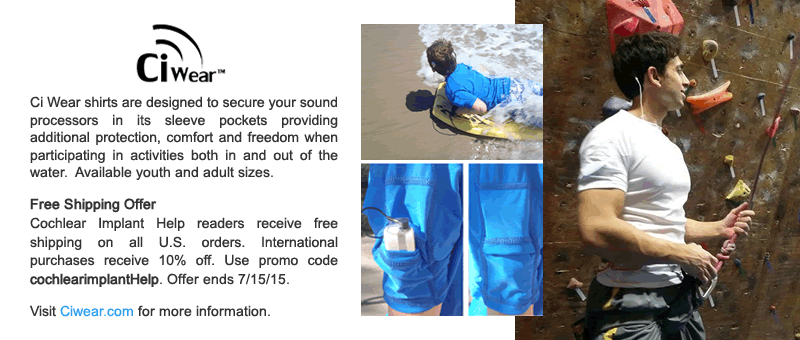
37ba4bb6d5-Ci-Wear-TM-logoCiWear and Cochlear Implant HELP are proud to offer free shipping on CiWear merchandise to the Continental US until 12/31/2015.  Use voucher code ‘cochlearimplanthelp’ at checkout.

The folks at CiWear who make the shirts that hold off-ear cochlear implant processors securely and manage cables now offer shirts in two different materials – one for swimming, and another for sports.

Ci Wear Swim

Ci WearTM teamed up with Victory KoreDryTM, a manufacturer with 30 years of experience in water sports gear, to manufacture our shirts in the USA. CiWear Swim

Key Features:

  • KoreDryTM fabric that is 80% nylon and 20% lycra
  • water-repellent
  • Breathable
  • Dries quickly so you stay warmer
  • Raglan sleeves and flatlock stitching for added comfort and flexibility
  • U.V. tested at UPF 50+ (equal to SPF 150+) factor both wet and dry giving it a rating you can depend on to protect your skin against the damaging rays of the sun when in or out of the water

Ci Wear Sport

Made with high performance premium quality Wicko active mesh for moisture management to keep skin cool and dry. Ideal for all your indoor and outdoor activities, including swimming. The lightweight, stretchable fabric combined with raglan sleeves, and flatlock stitching make for easy movement, flexibility and added comfort.

Key Features

  • Made of 100% Polyester
  • Quick drying
  • Breathable
  • Moisture management (wicking)
  • lightweight
  • Comfortable
  • Ideal for putting under uniform or wearing as a exercise shirt
  • Pockets fit the Neptune, AquaCase and smartphones and digital music players upto the size of an IPhone 6

Advanced Bionics announces FDA approval of two new sound processors

Naida CI Q90Stäfa (Switzerland), 18 August 2015 – Sonova Holding AG, the world’s leading provider of hearing solutions, announces today that its subsidiary Advanced Bionics (AB) has received FDA (Food and Drug Administration) approval in the United States for its new Naída CI Q90 and Q30 sound processors. FDA approval follows Health Canada approval earlier this year. Distribution of the Naída CI Q90 sound processor is expected later this year in the United States and Canada. The Naída CI Q30 is designed to meet the needs of the global market and will be available in specific markets outside of North America.

The new Q90 is the top-of-the-line processor in the Naída CI Q Series from Advanced Bionics, following the previous release of the Q70. Offering new PowerCel innovations that reduce size and improve battery life as well as new microphone technology for focusing on speech, the Naída CI Q90 now raises the bar as the premium choice for recipients who want the full line of features in the most compact package. Some of the advanced Q Series features include industry leading automation with new innovations that block obtrusive sounds, such as wind and echoes, to improve hearing in challenging settings. Supporting the Naída CI Q Series, the latest version of AB’s signature fitting software, SoundWave 2.3, also received FDA approval.

And directly from Advanced Bionics:

The Naída CI Q90 is the top-of-the-line processor in the Naída CI Q Series from Advanced Bionics, following the previous release of the Naída CI Q70, which raised the bar for superior hearing. Offering new microphone technology for focusing on speech, the Naída CI Q90 now surpasses the bar as the premium choice for recipients who want the full line of features.

New and current Naída CI Q70 recipients** can also benefit from some of the advanced new Q Series features, including new innovations that automatically reduce obtrusive sounds, such as wind, echoes, and sudden loud noises to improve hearing in difficult environments.

The Naída CI Q30 sets the bar for the Q Series family, offering proven AB and Phonak technology that lead the industry for hearing in noise and the option of the smallest PowerCel battery to date, compatible with all Q Series processors.

Available for the Naída CI Q70 and Q90 sound processors, Phonak Binaural VoiceStream Technology™ gives two Naída CI processors the unique ability to work together for improved hearing in challenging situations. Sound from one side is transmitted to the other side so that recipients hear the sound in both ears at the same time while distracting noise is reduced. No other manufacturer can offer the extraordinary binaural benefits this technology provides for effortless communication.

The only sound processor family that delivers hearing as unique as you are, the Q Series provides state-of-the-art technology designed to help recipients communicate with confidence, enjoy music, and stay connected to the latest consumer electronics.

• Proven technologies for better speech understanding

• Automatic adjustments for any environment

• Superior advancements for hearing in noise, on the phone, and in water

• The broadest and most proven portfolio of wireless connectivity accessories, including the new Phonak EasyCall accessory and Phonak DECT Phone

• Groundbreaking innovations in maximizing hearing with two ears working together

The latest version of SoundWave, AB’s signature fitting software, will soon be available to clinicians for enabling the new features.

AB Processors to be Compatible Wirelessly to Home Phones

DECT phone

No intermediary device required!  Connect directly to the Phonak DECT phone, or use the Phonak EasyCall to connect directly to your existing  Bluetooth-equipped mobile phone, and Naída CI Q70 sound processors.

Advanced Bionics announces future compatibility with Phonak EasyCall and Phonak DECT Phone.

The Phonak EasyCall* accessory is designed to provide universal, discreet, and hassle-free communication with any Bluetooth®-enabled mobile phone.

  • Attaches directly to the phone
  • Streams directly to both ears for best sound quality and speech intelligibility
  • Supports all brands of cell phones, including iPhone and Samsung
  • No intermediary device needed

The Phonak DECT Phone* is a cordless phone for everyone that provides an easy-to-use phone option at home or at work.

  • Enjoy calls on your landline phone
  • Transmit sound directly to one or both ears to reduce noise and maximize speech understanding – hearing aid users experience 40% better speech understanding¹
  • One solution for the whole family – family members without hearing loss can use the DECT Phone just like a regular phone
  • No intermediary device required