Is Cochlear developing a single-unit processor like the MED-EL RONDO?
More information on the Cochlear Kanso single unit processor is available here.


Is Cochlear developing a single-unit processor like the MED-EL RONDO?
More information on the Cochlear Kanso single unit processor is available here.
MED-EL’s Inside Story videos of the latest developments in the CI world are now available on MED-EL’s Facebook page.
Learn about MED-EL’s accomplishments with MRI, and what to expect from the world’s largest conference on cochlear implants and developments in the .

May 9, 2016 – (DURHAM, NC) – In celebration of May’s Better Hearing and Speech month, hearing implant leader MED-EL announced the launch of their first-ever Spotify playlist designed specifically for cochlear implant users. Spotify is a desktop and mobile streaming music service that offers free and paid subscriptions. Cochlear implant (CI) users are invited to follow MED-EL on Spotify and share the MED-EL Music for Cochlear Implant playlist with friends and family.
MED-EL announces the launch of ‘Inside Story’, a series of broadcast-quality videos with leading researchers about their areas of interest such as music, older adult, pediatric, hearing preservation, etc. ‘Inside Story’ will premier at CI2016, the 14th International Conference on Cochlear Implants and Other Implantable Technologies,. The conference will be held on May 11-14, 2016.
The videos will be posted on YouTube and Facebook.
Read the press release from MED-EL for more information.

Boston, MA, USA (April 1st, 2016) Boston-based biotech startup Cyberdyne Systems has announced the world’s first truly universal cochlear implant headpiece. The OneWorld™ headpiece automatically detects the model of the processor and of the internal implant, and acts as a translator between them. With the OneWorld™ headpiece, processors from any cochlear implant manufacturer will work with implants from any manufacturer.

Carbon Fiber
For example, if you have a MED-EL implant and would like to use the wireless accessories for the Advanced Bionics Naída CI Q90 or Cochlear Nucleus 6 processors, you can switch to those processors at the time of your next upgrade. And the OneWorld™ headpiece will make your implant compatible with the processor.
Or if you have a Cochlear brand implant, and would like a processor with the Advanced Bionics T-Mic, the OneWorld™ headpiece will ensure compatibility.
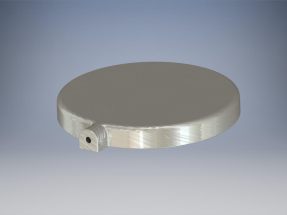
Titanium
The OneWorld™ headpiece uses the highest-grade rare earth magnets, resulting in the world’s lightest and lowest profile cochlear implant headpiece. The low profile enhances compatibility with more hats and helmets. The flat outer surface is designed to accommodate commercial and hand-made decorations without unsightly cuts or wrinkles.
Case options include carbon fiber, titanium, and a variety of colors in medical-grade plastic.
If you have access to your desired processor through your audiologist, family member, or friend, you may try out the OneWorld™ headpiece for 30 days with the ListenUp! program from Cyberdyne Systems.
For more information, and to be notified when the OneWorld™ headpiece becomes available, sign up here.

Cochlear has received FDA approval for the CI532, a member of the CI500 series cochlear implant. A new pre-curved, perimodiolar array, the EA32, is introduced into the cochlea through a straightening sheath. The array is shown at the bottom of the image.
No information is available as of yet on market availability.
Cochlear’s Mini Microphone 2 and Mini Microphone 2+ from ReSound are now available in the US and Canada.

Key Features of the Mini Microphone 2:
Key Features of the Mini Microphone 2+ include:
All the features of the Mini Microphone 2 PLUS:
For more information, see Cochlear’s marketing brochure.
World Hearing Day video highlights benefits of early treatment for childhood hearing loss
Global campaign to support World Hearing Day raises awareness of early intervention
Innsbruck, Austria – (March 3, 2016) – Today is World Hearing Day – an initiative led by the World Health Organisation (WHO) to raise awareness about the impact of hearing loss. The WHO estimates that around 360 million people (or approximately 5% of the world’s population) live with disabling hearing loss; of these, nearly 32 million are children. This year’s theme ‘Childhood hearing loss: act now, here is how!’ will raise awareness about public health strategies that help to reduce the prevalence and impact of hearing loss in children.
MED-EL, a leading provider of hearing implant systems, is supporting World Hearing Day with the launch of a new video, Through the ears of a child. The video highlights the potential advantages of treating childhood deafness or hearing loss at an early age, when children are first exploring the world around them and learning to engage with their peers.
The video is also being backed by HEARRING, the global network of hearing implant experts: “This year’s World Hearing Day focus on children strongly supports our HEARRING vision that early identification and intervention through implantation can help children with severe hearing loss,” said Paul Van de Heyning, Chair of the Scientific Committee at HEARRING. “Treating children with hearing loss early gives them a better chance of reaching their full developmental potential. Together as health professionals, we must work globally to reach as many children as possible and restore the gift of hearing to them.”
The ‘Through the ears of a child’ video brings to life the different ways that young children experience the world when they are struggling with hearing loss, and how their life can be transformed when their hearing becomes restored.
Research shows that children, whose hearing is profoundly impaired before they learn to speak, are more likely to benefit from treatment with a hearing implant if it is given at a young age. These children start to receive auditory information at a time when their brain is especially ready to learn language. Therefore, their hearing and speech has an opportunity to develop in a manner similar to that of their normal hearing peers.
Visit www.earsofachild.com to view the video from MED-EL’s international headquarters and learn more about the ways in which childhood hearing loss may be prevented and treated.

Mini Microphone 2+
The new Cochlear Mini Microphone 2 and Mini Microphone 2+, by Resound, will be available for Cochlear Nucleus 6 users soon.
Starting March 8th all system and upgrade orders will automatically default to the Mini Microphone 2+ when the Mini Microphone is selected. Patients who ordered the first generation Mini Microphone between March 1 – March 8, 2016 as part of an upgrade or system order will be able to exchange it for a Mini Microphone 2+ at no additional cost if desired. For all other orders, Cochlear’s standard Return and Exchange policy applies. We anticipate shipping the Mini Microphone 2+ beginning March 21, 2016 and the Mini Microphone 2 will be available later in the spring.
Information on the Mini Microphone 2+ is available in the ReSound Multi Mic datasheet.

Cochlear is testing a single-unit external processor similar in form factor to the MED-EL RONDO. With a code name, or perhaps eventual market name of Kanso, the processor operates on 2 675P high-power zinc-air batteries. And like the RONDO, a tether is available to help retain the processor if it falls off.

Unlike the RONDO, the Kanso has a multi-function button which enables a small set of adjustments. In child mode, the button is used to change programs. To change volume or sensitivity, the audiologist must enable the features to be adjusted by the CR210 Remote Control or the CR230 Remote Assistant.
Combinations of long and short presses on the button allow the user to select external inputs, including a built-in telecoil and a sequence of any paired wireless accessories. The wireless capability is a substantial difference between the Kanso and the RONDO.
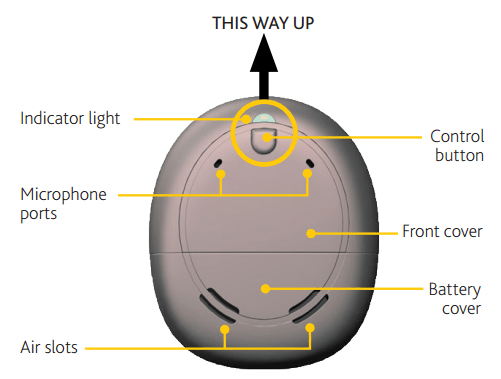
The two microphone ports allude to some implementation of a zoom feature, which is helpful in noisy situations. Like the RONDO, the processor sits directly over the implant magnet, which may not be the ideal location. A zoom program is likely to be very useful.
The Kanso is programmed to work with only one implant, so it won’t work if you are bilateral and put it on the wrong side. It does not seem to have the capability of recognizing which ear it is on and loading the appropriate programs.
To learn more about the Cochlear Kanso, read the draft User Guide.
 cochlear implant HELP