Ditto Vibrating Alarm and Notification Device

by Howard Samuels

ditto-wearable

Read this review to receive a discount code on Ditto!

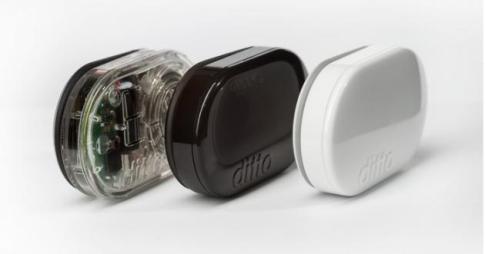
Ditto is a small device that vibrates to provide you with alerts from your phone. It is focused on that one task, eschewing the feature creep that plagues so many consumer products.

From the manufacturer:

We created Ditto as a kind of anti-gadget – something to free people from worrying about their smartphones and to be more present in life. Ditto is tiny and elegant. No buttons, switches, lights displays, or cables. Less is more.

Ditto vibrates when you get an incoming phone call, a text, an email, or a notification from a large and growing portfolio of third-party apps.  You don’t have to be inundated with constant vibrations, however.  You can choose which apps will cause the Ditto to vibrate, and you can also select important people from your list of contacts, or allow alerts from anybody.

Straying ever so slightly from the ‘simple is better’ mantra, Ditto can also alert you when you are far away from your phone.  This is helpful if you are prone to leaving your phone behind – Ditto will vibrate before you get too far away. The distance varies, but it is basically the range of the Bluetooth connection.

For cochlear implant HELP readers, perhaps the most important function is Ditto’s ability to vibrate at a preset time – it’s an alarm clock!  Rather than large and expensive bed shakers or flashing lights, you can clip Ditto to your sleepwear, or wear it on the included wristband.  My preference is to use the wristband because I can leave it on all day and all night. Ditto is waterproof, so you can wear it in the shower.  The included thin and durable neoprene wristband looks great, but it does tend to stay wet for quite a while. And because it vibrates on your wrist, it won’t wake up your partner.

ditto-alarm-set

To set an alarm, go to the Alarm screen, choose one of the alarms to set, and set the time of day.  You can assign a name to the alarm to be displayed on your phone when the alarm occurs.  This can be helpful if you have set several different alarms and need to know which one is begging for your attention. The alarm can be set to vibrate its pattern one time, or it can repeat every two minutes for ten minutes, or until you turn it off.

Once an alarm has rung, it stays off unless you enable it again in the Ditto app.  A recurrence feature would be helpful, so that you could set the alarm to wake you on the days you work each week without having to remember to set the alarm each night.

The Ditto web site has some short instructional videos to show you how to set up Ditto, attach it to the wristband, change the batteries, etc.  The videos are available from within the Ditto app as well.

Ditto uses a single CR1632 button cell disposable battery, which lasts 3-6 months.  When the battery gets low, you receive a notification to change the battery soon. The CR1632 battery generally isn’t sold in local pharmacies, but it is readily available from Amazon and other online sources.

Ditto is far more convenient and portable than traditional alarms targeted at the deaf and hard of hearing market.  Because it is a high-volume consumer product, it costs much less than dedicated wakeup systems.  And its main purpose of notifying you when you receive phone calls, texts, etc, is very useful. Ditto is a cost-effective alternative to a smart watch if the only goal is to receive notifications from your phone. Two additional features would make it a perfect fit – recurring alarms, and a wristband that dries more quickly.

Cochlear implant HELP reader can enjoy a 20% discount until October 31st, 2016, by using discount code cochlear20!

Two Ditto devices were provided by Simple Matters for the purpose of this review.
Kanso Receives FDA Approval

Kanso

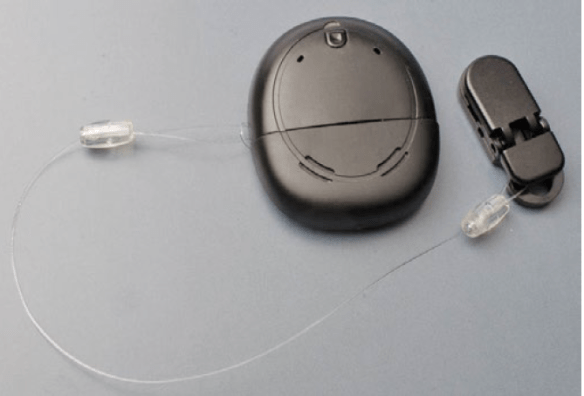
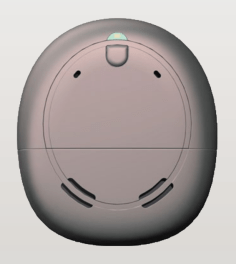
Cochlear’s newest processor, the single-unit Kanso, has received FDA approval in the United States.  The features are largely the same as the Nucleus 6, but packaged in a convenient single-unit form factor.

Read the Kanso user guide here.

Choosing a Cochlear Implant that Works with a Hearing Aid

By Jessica Lewis

The journey to begin the process of cochlear implantation is an exciting prospect. When your audiologist tells you there may be hope to regain hearing and comprehension, the potential seem limitless. Amongst the excitement and new possibilities, the process of cochlear implantation can be overwhelming, and it’s not a decision to be made overnight.

My first step after making the decision to move forward with implantation was to learn about how cochlear implants work – not a deep technical perspective, just an overview such as can be found in the videos on the manufacturer’s web sites.  In particular, I was interested in understanding the differences between cochlear implants and hearing aids.   

When I began my cochlear implant journey last year, I had to choose which implant and company I would partner with for life. And they all promised better-than-ever features over the others. I was told by my audiologist all the general bells and whistles of the different implants, but ultimately she just handed me big packets of information on the three brands: MED-EL, Advanced Bionics, and Cochlear and said, “it’s up to you!”

The first step to any decision is to research every possible outcome. Brand packets in hand, I meticulously combed through each one hoping to have one company stand out over the other. But unfortunately, all three brands look like they offer similar implants, with very small distinctions between them. This was where I decided to hit the pavement and go straight to the sources. My audiologist was kind enough to get me in contact with representatives and implant recipients for Advanced Bionics, Cochlear, and MED-EL. I set up meetings over coffee, chatted via email, and took voluminous notes throughout the process. I truly felt this made my decision easier, as I was able to discuss and listen to first hand experiences: the good, the bad, and the ugly.

I qualified for a cochlear implant in both ears, but I decided to only implant one for now as I can still use a hearing aid in the other ear. Many cochlear implant recipients are bimodal, meaning that they use one cochlear implant and one hearing aid.

While you can use any hearing aid with a cochlear implant, they really are different devices, and process sounds differently.  Successful bimodal users learn to adapt to the different inputs to each ear.

Sister companies Advanced Bionics and Phonak recently introduced the Naída bimodal hearing solution, consisting of a cochlear implant with a Naída CI Q90 processor, and a Naída Link hearing aid.  The sound processing technology is the same for both instruments.  And the volume behavior (the way the loudness is adjusted automatically) is also the same. My hope is that this will make the transition to becoming a bimodal user as effortless as possible, and that it will provide me with the best bimodal hearing experience.

One nice feature available now is that when you change program or volume by pressing buttons on either instrument, both instruments respond, and you can hear the beeps in both ears.  Also, you can stream sounds to both instruments using a ComPilot or a Roger Pen.  

Some new features are coming soon that will make the Naída Link system even more integrated.  I look forward to programs such as DuoPhone, where you hold the phone up to one ear, and the sound is streamed wirelessly to the other, so you hear it in both ears!  And StereoZoom uses the mics on the two instruments together to make a super-tight focus directly in front of you – perfect for noisy restaurants!

Needless to say, I made the decision to go with Advanced Bionics because of all the features for bimodal users like me.

Naida bimodal

With both the Link and implant,  I am able to hear sounds that I haven’t heard since my hearing loss began (including my cat’s incessant meowing which I’m not sure I missed…). I’m able to capture wonderfully clear sounds and speech with just the implant itself, but the addition of the Link adds such a richer sound to my surroundings, adding a more natural tone. I can carry on conversations in restaurants with ease, hear my boyfriend calling me from another room, and even talk on the phone with the T-mic or my Roger pen streaming into both ears. It’s astounding how clear I am able localize sounds through these intelligent and cohesive devices; two ears are definitely better than one!

Going forward, I can’t wait to see what additional features Advanced Bionics and Phonak will offer bimodal users.

About the Author

Jessica LewisJessica Lewis is a twenty-two-year-old recently hired pediatric oncology RN. Her hearing loss started in 2014 warranting the use of bilateral hearing aids until becoming a cochlear implant recipient in 2015. She was implanted June 30th, 2016 and activated on July 14th, 2016 and received her Naida Link a week later. She currently resides in Jacksonville, Florida where she hopes to not only change the lives of her pediatric patients but also advocate for the deaf/hard-of-hearing community she so closely relates with. She strives to pave the way for awareness and recognition of this community in introducing new technology and communication techniques through her experiences both medically and professionally.


Cochlear Receives FDA Approval for MP3000 Sound Strategy

MP3000, a new sound strategy from Cochlear, has received FDA approval.  The strategy promises to extend battery life about 24% over the existing SPEAK/ACE strategies.

While SPEAK/ACE are based on 8-10 spectral components, MP3000 uses 4-6 components. No significant difference was found for the speech scores and for coding preference between the SPEAK/ACE and MP3000 strategies.

Thanks as always to Bob MacPherson for breaking the news of FDA approval of the MP3000 sound processing strategy!

Cochlear Kanso User Guide

Kanso safety lineLearn more about the upcoming Cochlear Kanso single unit processor!  This preliminary user guide can provide lots of information if you are considering getting a Kanso.
Cochlear Receives FDA Approval for MRI on Several Implants

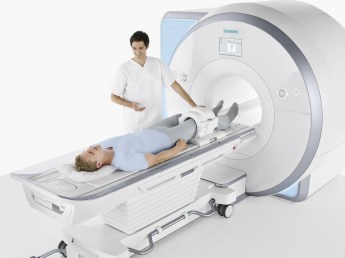
mri-magnetom-skyra-mediaviewer_10-00092827-10The US FDA Approves many Cochlear (brand) implants for 1.5T MRI with magnet in place with the use of the Cochlear Nucleus Implant Bandage and Splint Kit, and for 3.0T MRI with magnet removed.

The following Nucleus Profile and Freedom implants are covered with this approval:

• Nucleus Profile: CI512, CI522, CI532
• Nucleus CI24RE: CI422, CI24REH, CI24RE(CA), and CI24RE(ST)

*Does not apply to CI24R, CI24M, CI22M

FDA notice of PMA supplement approval

Credits to Bob MacPherson for coming up with the scoop!

Advanced Bionics / Phonak Naída Bimodal Solution Seminars

Naida bimodalSave the date!  Advanced Bionics is hosting a series of seminars providing information about how Naída cochlear implant processors and Naída hearing aids.

Discover the benefits of AB’s newest innovation—the Naída bimodal hearing solution. This interactive, hands-on seminar is for anyone considering a cochlear implant and unilateral AB recipients. The event will provide participants with the opportunity to learn about the Naída bimodal hearing solution, wireless communication, and aural rehabilitation resources.

For more information, see the flyer.

CochlearImplantHELP has always provided news of new cochlear implant products, oftentimes before the official manufacturers’ announcements. We are pleased to announce local informational events about new products and features hosted by cochlear implant manufacturers. Please use our contact form to submit manufacturer flyers for consideration.


MED-EL SONNET Rechargeable Battery Announcement

SONNET Rechargeable Batteries Image

As reported earlier on cochlear implant HELP, MED-EL announces FDA approval of rechargeable batteries for the SONNET processor, and also approval of the Mini Battery Pack for SONNET.

The rechargeable batteries will be available in a standard size with up to 10 hours of listening, or micro size, battery life not reported. The rechargeable batteries are compatible with WaterWear.

The Mini Battery Pack will house a single AAA battery in an off-ear configuration, with up to 37 hours of battery life.

MED-EL WaterWear for OPUS 2 and SONNET Coming Soon

WaterWear_BTE

MED-EL announced that WaterWear covers for the OPUS 2 and SONNET processors will be available late summer 2016 in the United States. Note that Zinc-Air batteries do not work in an airtight environment, so most likely 675 LR44 button cells will need to be used in conjunction with WaterWear.

In related news, MED-EL also received FDA approval for a rechargeable battery for the SONNET processor, which may work in conjunction with the WaterWear, making 675 LR44 batteries unnecessary. Also, a Mini Battery Pack and Cable have been approved for the SONNET, which may be an off-ear power solution unrelated to WaterWear.

Advanced Bionics and Phonak Announce Bimodal CI/HA Streaming

The_Naída_bimodal_hearing_solution_from_Advanced_Bionics_and_Phonak_webready

Advanced Bionics (AB) and Phonak announce the introduction of the new Naída bimodal hearing solution featuring the Phonak Naída™ Link, the world’s first hearing aid offering full-bandwidth, bidirectional audio streaming with the Naída CI sound processor from AB. Using shared technology co-developed by AB and Phonak, the Naída devices are able to communicate with each other in a way no other hearing aid and cochlear implant combination can match.

Bimodal features may include functions such as DuoPhone, in which you hold the phone up to one ear, and hear the sound in both ears. The direct communication between the cochlear implant processor and the hearing aid may also allow you to change program or volume on both instruments by pressing a button on either one of them. Currently these types of functionality are only available for bilateral Advanced Bionics cochlear implant users, or bilateral Phonak hearing aid users.  About half of all cochlear implant users are bimodal, meaning one cochlear implant and one hearing aid. These users will be able to take advantage of features previously available only to those with two cochlear implants or two hearing aids.

For more information, see the press release.