William Demant Acquires Neurelec

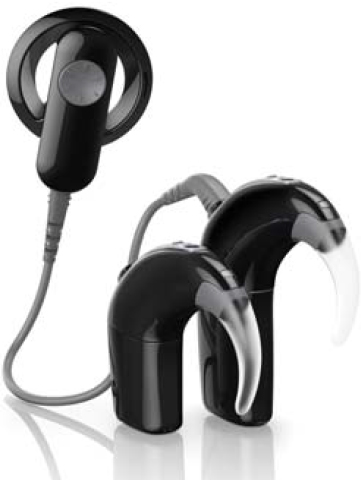
In the latest move in the cochlear implant industry, William Demant Holding Group has acquired French cochlear implant manufacturer Neurelec.

William Demant is the parent company of Oticon, known for hearing aids, and more recently, bone-anchored hearing aids.

Fully Implantable CI Patent Application from Cochlear

This is an April Fool’s post.  Cochlear Implant HELP strives to provide timely and accurate information.  So as not to mislead our readers, we now identify April Fool’s posts that mention specific cochlear implant manufacturers with this header.  Our posts often hint at features that would exceed the hopes of many of our readers by far.  While the posts are intended in jest, they do reflect some of the wishes of the community, and manufacturers might benefit from accepting these as inputs for longer-range product possibilities.

Cochlear leaps ahead in the fully-implantable technology race.

Cochlear has submitted a patent application to the US Patent and Trademark Office for a fully-implantable cochlear implant.  While there are already many patents by all manufacturers for these devices, this one seems to go way beyond the state of the art.

The biggest advance seems to be in the surgical technique.  Because the electronics are on a flexible ‘board’ they can be rolled into a cylindrical shape.  Starting with the electrode array, the entire assembly is inserted through the nostril.  Conventional arthroscopic instruments are inserted through the opposite nostril, and also through a small incision in the ear drum.  There is no shaving of hair, no incisions other than the ear drum, and no waiting period before activation.

While the surgical technique is not claimed in the patent, it seems the surgery may be performed with a mild sedative and a local anesthetic.  Because there is no need for swelling to dissipate or incisions to heal, the implant may be activated on the day of the surgery.

To charge the battery (or super capacitor) just keep a charging box next to your bed, and the power is transmitted wirelessly while you sleep.

Key points in the claims:

  1. The electronics are on a flexible substrate, which may be rolled up for nasal insertion.
  2. Use of a supercapacitor instead of a battery.
  3. Insertion of the electrode array through the Eustachian Tube.
  4. Unrolling the substrate so it lies flat in a sinus cavity.
  5. Wireless radio-frequency charging.

Read the full patent application here.

New Product Announcements?

With Advanced Bionics, Cochlear, and MED-EL all preparing to announce new processors, a room full of professionals is always a good place to watch.  There aren’t many cochlear implant conferences coming up, so the British Cochlear Implant Group conference on March 21st and 22nd bears close scrutiny.

The programme includes time for AB, Cochlear, MED-EL and Neurelec to provide manufacturer’s updates.  While CochlearimplantHELP.com has no specific product introduction information, we have been reporting on the upcoming devices.

Advanced Bionics:

AB_New_BTE_2

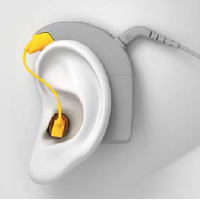
AB is readying a new processor with wireless capabilities and features from Phonak.  You can stream the phone audio from one ear to the other (another AB implant or a Phonak hearing aid).  Connect to phones, music players, etc. via BlueTooth through the ComPilot.  More information is available in this brochure.

Cochlear:

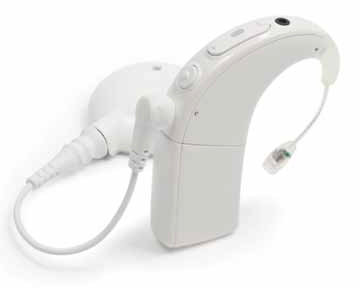
Cochlear_N6

The Nucleus 6 processor will be available in two sizes – with or without an accessory port.  The processor may offer wireless capabilities using the remote as a gateway device.  And it may be possible to program the processor remotely!  The Nucleus 6 will also be able to act as a hybrid hearing aid / cochlear implant, using the Acoustic Component.

Acoustic Component

MED-EL:

Rondo_2

MED-EL has been busy as well, preparing the RONDO one-piece processor.  This is the world’s first processor to be completely self-contained. The batteries, processor, and headpiece are all one unit.  Nothing sits on the ear at all!

Neurelec:

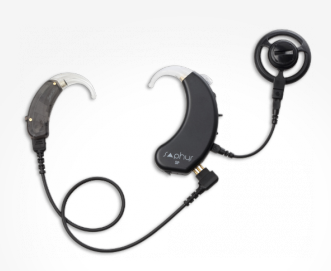
saphyrThis French cochlear implant manufacturer has a time slot to provide an update at the conference as well.  The current system from Neurelec is very creative – one implant has two arrays, one for each cochlea!  Externally, the Saphyr processor sits on one ear, and a wired microphone is on the other ear.  This system provides true stereo sound.

Interview with Stuart McNaughton, author of He Is Not Me

What difference has your cochlear implant made to your life?

Well, in a nutshell, I am no longer dependent on others.  Since I was implanted, I have traveled all over the world, frequently on my own.  I became so confident that I even went to Australia for nine months.  I tried my best at learning the Finnish language, completed my accounting and marketing studies and then went on to do a Master’s degree.  None of these would have been possible without my cochlear implant.  In truth, I am incredibly dependent on my implant.     

What inspired you to write He Is Not Me?
I actually started writing He Is Not Me more than ten years ago.  Back then, there were very little – if any – accounts of cochlear implantation out there for people to read, and my original aim was to be among the first to write an account.  The more I wrote, however, the more I remembered about what I call ‘the bad times’.  These bad times were so harrowing that reliving what I thought I had forgotten made me put down the manuscript, sometimes for months at a time.  What inspired me to carry on was the hope that, one day, my book would make just one person start the amazing journey I have been on since 2001. 
Tell us more about where the name of the book came from.
The name of the book only came to light very recently, as I was nearing the end of my writing. My cochlear implantation has had such a profound effect on me that I no longer relate to the ‘old me’, and that is where the name of the book came from – he is not me.  It’s really that simple. 
Why is your story different?
Whilst I like to think that we are all different, many of the deaf and hard-of-hearing, and those with cochlear implants will relate to different phases of the book, whether it be the bullying, being discriminated against, being in the care of an audiologist etc.  As the book started to take shape, the common theme that emerged was that, without my family, I would not be where I am today.  Without my parents fighting a system that tried to stick a label on me and confine me to the deaf world, I really would not be where I am today.
What do you hope readers gain from your story?
Different people will relate to the book at different stages.  For example, I talk about the many healthcare professionals who ‘put me back together again’ – they will get a really in-depth account of what a cochlear implant recipient was thinking and feeling, things that rarely get spoken about during a thirty minute medical consultation.  My biggest hope is that parents out there will learn that this technology exists, and realise that there are options for their child.  Whilst it is their choice to decide what is best for their child, to be forewarned is to be forearmed, is it not?  My parents are really my heroes, and this is apparent throughout the story.  In fact, my own mother has written a foreword for He Is Not Me, and I think many mothers out there will relate to what she writes in her own words.
What do you think your parents’ advice would be to the parents of deaf children today?
I am laughing at this very question.  In fact, I just called my parents and my mother answered the phone.  I posed this question to her, and this is what she said: get lots of advice, do the research, but don’t delay.  I guess this kind of ties in with the Author’s Message on the He Is Not Me website, in which I state that I honestly didn’t start living until I was twenty-three, the day I got my cochlear implant. 
Are you considering bilateral implantation and, if so, what do you hope to gain?
I have considered bilateral implantation for a long time.  It can be frustrating not knowing exactly where sound is coming from, but more importantly: I have nearly been run over twice as I have been unable to hear oncoming traffic.  Indeed, I was run over once – and pushed – to the floor by a speed biker in London.  I think he thought he was Lance Armstrong! 
What technology or advancement would be a ‘dream come true’ for you in cochlear implants or the hearing industry?
I have had my cochlear implant for more than twelve years, and I am absolutely astounded by how durable it is.  You would not expect a flat screen television, or a mobile telephone to function for that long, would you?  To ask for more would sound ungrateful, almost disrespectful to the many people who work tirelessly on cochlear implant development.  There has been talk about fully implantable systems, but to be honest, I like the idea of returning to the deaf world each night.  But the minute I wake up, the sound processor is back on.  For me, a life without sound isn’t a life at all.
Stuart McNaughton is a Manager of the Bionic Ear Association, sponsored by Advanced Bionics, and author of ‘He Is Not Me’.  For more information, visit www.HeIsNotMe.com.
MED-EL Hosts Two California-based “Hands on Hearing” Workshops

Cochlear implant technology has opened up a new world of hearing and improved the quality of life for many people. As an added bonus, there is technology available that can improve personal listening experiences even further. Often called assistive listening devices, these tools are becoming popular accessories for people with hearing loss by providing enhanced hearing experiences in a wide variety of ways:

·        Enjoy a concert, performance, or seminar as if the speaker was right next to you.
·        Engage in a quieter, more personal hearing experience when you’re watching TV or listening to your iPod.
·        Connect to your telephone to provide a clearer listening experience
·        Learn about more tips and tricks that may help you get the most out of your hearing device.
Download the official flyer here.

Congratulations Bob MacPherson!

HOH_BobThe team at CochlearImplantHELP would like to send belated congratulations to Bob MacPherson and his Yahoo group bhNEWS for 13 years of dedicated service to the HOH and cochlear implant communities. May there be many more!

“We are hopeful”: Cochlear implants campaign gets boost

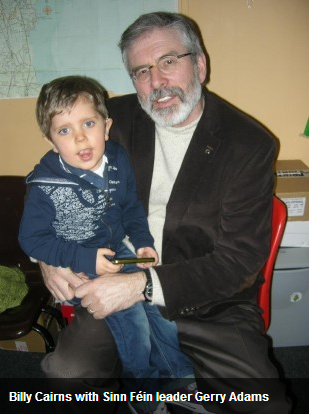
Billy Cairns and Gerry Adams

THE CAMPAIGN IN IRELAND RUN BY parents to have children fitted with two cochlear implants instead of the standard one has received a new boost.

Sinn Féin leader Gerry Adams is among those who has pledged his support to the Happy New Ear campaign, and met with Deanna Cairns and her son Billy (4) last week after he brought up the issue in the Dáil.

Read more!

Interview with Author Arlene Romoff

ArleneThe American Academy of Audiology interviewed Arlene Romoff about bilateral cochlear implants and implant failures.  Read more!

First Retinal Implant to Receive FDA Approval

video-bioniceye-approved-articleLargeThe Food and Drug Administration on Thursday approved the first treatment to give limited vision to people who are blind, involving a technology called the “artificial retina.”

With it, people with certain types of blindness can detect crosswalks on the street, burners on a stove, the presence of people or cars, and sometimes even oversized numbers or letters.

Developed over 20 years by Dr. Mark S. Humayun, an ophthalmologist and biomedical engineer at the University of Southern California’s Doheny Retinal Institute, the artificial retina was inspired by cochlear implants for the deaf.

Read more on the New York Times.