One woman’s CI adventures with Music!
Going from normal hearing to zero hearing while I slept was quite the reality to wake up to! My days of singing, playing guitar and clarinet came to an abrupt halt. Just like that. I was only 17 and it was the most unexpected thing you can imagine!
I had already spent fourteen years in silence (no hearing aids) when my sister read an article in the newspaper about a man in a neighboring town that got a cochlear implant. This was 1985. We immediately contacted the surgeon and make arrangements for an assessment for me.
I passed all the tests with flying colors and before 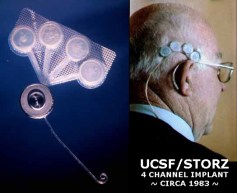 I could blink, I received a “Storz-4 Channel” device in the 5 hour surgery. I spent 5 days in the hospital (really!!) and waited 6 weeks for activation. I had no expectations at all. All I wanted was to hear sound again. I didn’t know a soul with a CI and was not allowed to meet the fellow in the next town that had one. I think we would have both benefited if we had been allowed to meet.
Turn on day was interesting! I had two audiologists, one in Connecticut and one in California. The California audiologist had to fly across the country to map me and any time I had a problem, she had to hop on a plane! (Thank you, Dorcas!)
I could immediately hear environmental sounds. I could hear the phone ring, could hear the dishwasher change cycles, toilet flush, doorbell, car horns honking, helicopters etc.
I could hear speech, tell the difference between male and female voices, but couldn’t understand what they were saying.
Music: Oh how I missed it!! I tried in vain to listen and understand music with my device. My mother would put on something and I would try to guess what it was. I was never able to guess, it was seriously nothing but electronic mush. Never sounded like music, just noise, and unpleasant noise at that!
My device was starting to fail, only 16 ever implanted in the world, and my electrodes failed one by one until I was left with just one. The phone ringing went away, it was a slow failure. Finally the day came when I had to take the headpiece off and go back into the silent world. There was no replacement available.
Fast Forward to 2001. A friend sent me an email saying I should check out cochlear implants again. She read an article and thought maybe it was time for me to look at them again. I delved into the CI world via the internet. I was surprised I actually had choices in the matter and took this very seriously indeed!
June 18th 2002, I was in for my second cochlear implant surgery. I was implanted with an Advanced Bionics (AB) CII device. I wanted to have the right ear done again and “save” the left ear for the future. My surgeon convinced me to start fresh and go with the other ear.
Activation day was a month later. It was loud, overwhelming and crazy! I had ducks quacking for speech, not “Donald Duck”, but actual ducks quacking. I had female and male quacks! I was activated with an older traditional program called CIS. This program is universal to all the CI companies and dates back to the early 90’s.
My daughter decided to give me a “hook up gift” and we went to the CD store on activation day. I was gifted a Walkman CD player and 17 music CD’s!
I got home with all my music purchases and literally had to figure out how to work the Walkman and how to open the CD cases! I lost my hearing in 1971, I had never used a CD, did not even know how to work the car radio, or listen to music with anything other than a record player!
I had to listen to music. I just had to. I had CD’s that spanned decades. My daughter had to choose most of them for me. I started with Elvis. Nope, couldn’t really tell what I was listening to. I tried several other CD’s and still no great luck. I had a vague impression of recognition on a couple of songs, but that was about it.
The next morning I immediately got the music out again. This time I chose Creedence Clearwater Revival, and I recognized “Suzy Q”!! I was stoked! I actually recognized the song and beat! I could not understand the lyrics, but the beat had me dancing around the house! It really did sound lousy as all get out, but it was something…when before I had nothing!
For my birthday that year, my daughter Tara surprised me with tickets to the Paul McCartney concert at the Anaheim Pond stadium in Los Angeles. I had a good 4 months of hearing under my belt by then and was excited to get to go to a concert! We had 10th row center seats, drove in from Newport Beach in a limo, it was quite the experience!
The concert was different than I was expecting. I was expecting them to announce the name of the song so I could see if I could remember it. Didn’t work that way, they just started playing song after song and expected everyone to know them. Tara had to tell me what was playing. Once she did that I either remembered it or I didn’t. I recognized about 25% of the Beatles songs, but not until I was told the name of the song. Didn’t get any lyrics, and it really didn’t sound that good. I was just happy to experience a concert and feel the excitement again!
At the end of 2002 my audiologist asked if I would like to be involved in some clinical trials that AB was doing. I had to pass an assessment test. Both my friend Judy and I passed this test and we both were selected to be in the “Auria” trials.
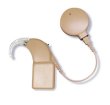 The Auria was a new behind the ear processor (BTE) that AB was coming out with. I had no idea I was also going to be upgraded to the next generation software technology as well! Both Judy and I were fitted with an Auria and AB’s new software technology called High Resolution or HiRes. We were stunned!
The upgrade from CIS to HiRes was an immediate success with improvements across the board with both speech and music.
The lyrics in music became much more noticeable compared to CIS. At one point after we got back to the hotel, both Judy and I had our Walkman’s out and we were testing our music. We were sharing a room and I glanced over at Judy to see tears running down her face. I went over to her and asked her “what was wrong”? She said “nothing, I can finally clearly hear Johnny Mathis’s voice”! Judy had been deaf for 50 years and it was the first time she could hear the lyrics.
Music for me took on better quality, deeper tones, and like Judy, I could now hear much more of the lyrics. It was not 100% of the lyrics, but I guess I got about 30% more than I did with the traditional CIS program.
During all the testing with HiRes, I had developed a list of certain songs I used to compare things with. I had Elvis, CCR, the Temptations and Patsy Cline. I chose them all because I grew up with this music and knew it well.
 Patsy Cline’s song “Crazy” was the one I used the most. With the CIS program I could get the gist of the song, knew it was “Crazy” and it sounded country (ish). I did not recognize Patsy’s voice. It was just a voice with vague slurry lyrics.
Upgrading to HiRes with the same song was quite the eye opener. I recognized the song immediately and the lyrics came through very well. Partly because I was getting more lyrics now, and partly because I had listened to it enough to know it well. Still, even with HiRes, the voice could have been anyone singing the song…I knew it was a female country singer and knew it was Patsy because I put on the music.
A few years after HiRes and the Auria were released, I was again invited to be in trials at AB. This time for the Harmony BTE trial. This particular trial was for the Harmony itself using the same programs I had already been using. I was asked to try music with the Harmony and compare it to the Auria.
Yes, there was another improvement in the quality of the sound. It turned out that the new technology in the BTE itself offered even better sound quality. This was with my normal HiRes programming. I was tested and had better test results with the Harmony as opposed to the Auria with the same programs.
Not long after the Harmony testing I was called to come to AB to try a new program. It didn’t have a name yet (that I knew of) but I was asked to bring my music.
I listened in wonder as my world of music went from 16 pitches with HiRes to 120 pitches with Fidelity 120! It was like someone tossed me pieces of a puzzle. I heard things in the music I had yet to hear with any CI program. Soft intros, warbles in voices, complex instrument interplay. Oh yes, oh yes!!!!!
Patsy Cline finally sounded like Patsy Cline. The voice I grew up with. It gave me a warm feeling.  When I hear her voice I think of my mom. Patsy was my mom’s favorite singer and her voice filled our house all the time. I miss my mom, but listening to Patsy brings a lot of good memories, and I know my mom would approve of how Patsy Cline’s voice sounds to me now.
This is where I am now with music with our current BTE and our current programs. I have beautiful music, not perfect music, I never expected the same music I had with perfect hearing…but it’s so close in many ways.
But hold on!
I was asked to try something new at AB again and to bring my music. No, it wasn’t the new ClearVoice program. It was something else.
The first time I tried it my jaw about fell in my lap. I can only say so much about this because AB has it in “in-house” trials. It’s the next big thing for music, and it’s going to rock the cochlear implant world!
My researcher set me up with the programs and said he had to go do something for a few minutes, leaving me with my music. I had the iPod loaded and Bose headphones on. I immediately went for the old standards and sat shell shocked. In all the years of silence, all the years of CI research, I had barely cried. I didn’t cry when I was activated, didn’t cry when I finally got Patsy Cline’s voice back.
I sat there with tears rolling down my face. I was stunned. The researcher came back and just looked at me and said “you’re crying”, I sniffed back at him, “no”, he said “yes you are” and I just laughed and said “I know”! He was so excited! I had been working with him for years and it was my first over the top reaction. The new program had the same results with everyone who had tried it. Everyone was in shock and super excited! Hopefully it won’t take long to get this program approved. We all deserve the best hearing we can have, and this next generation program is going to give a lot back.
We obviously have more to look forward to with CI hearing. Advanced Bionics takes music very seriously. Many of the researchers are musicians themselves. They have the technology that gives us what’s called “current steering”… and boy have they started to learn exciting things they can do with that technology!
Stay tuned!
Debra McClendon

 It is a very gratifying job. I tell people that it is a very emotional job. When you help someone hear for the first time in years, or for the first time ever, it is a high that cannot be matched by much. When an implant fails, that is one of the hardest conversations to have. The upside is that there is almost always a solution to get that patient hearing again.
 You know, there are always moments that stand out. Particularly emotional activations, kids’ reactions, those where you know that the restoration of hearing will give person’s life back to them… it’s all good.
 Dr. Kemper is very interested in how the CI patients are doing. He loves to hear about progress and milestones, though I probably don’t give him enough of that type of news. He always says that if he could see one or two implant patients a day, and witness their successes, he’d never have a bad day. We communicate about any issues that patients may be having, as well. He is very involved.

 cochlear implant HELP