Enter today to win a free trip to Cochlear Celebration 2013? Submit a video if you are a Nucleus or Baha recipient for a chance to win!
Author Archives: CochlearImplantHELP
Advanced Bionics Neptune Contest
If you or your child has an Advanced Bionics Neptune (or two) enter the contest today for a chance to win a GoPro HD waterproof video camera!
Cochlear Confirms Drop in Failures
Significant Drop in Implant Failures
All three cochlear implant manufacturers tracked by the FDA MAUDE database have shown a decrease in device failures in recent months. Read all about it on the MAUDE page.
The Sky is the Limit
How a young mother advocated for her son, getting him bilateral implants and Auditory-Verbal Therapy, and raised awareness in a health care system focused on containing costs.
Matthieu’s international journey from a position of little hope to reaching the sky
Newborn hearing screening didn’t exist in France in 2007, so my son Matthieu’s hearing loss was not diagnosed at birth. Because he was my second child I had doubts on his hearing abilities very soon, and Matthieu was diagnosed with a bilateral hearing loss at 5 months. He received his hearing aids right away and he started all the tests in case he would need a cochlear implant.
I started to search for information on the Internet, and to ask questions of the doctors. Everything that I found in French depressed me. I was on the verge of accepting that Matthieu would never be able to speak properly, and that he would have to go in a deaf institute far from home. The doctors told me not to expect too much of the cochlear implant. There was just one French forum where I could share my feelings with parents. And even though they answered my questions, they all told me that Matthieu would have to sign or to use cued speech, and that made me uncomfortable. I didn’t want to place any limitations on my child. I felt that he would have to learn to listen and speak to reach his true potential.
Then I looked at websites in English. There were SO many! There were blogs by parents, speech therapy websites, and more. I read everything eagerly. But what struck me was the websites created by the manufacturers. In French or in English the information was not the same AT ALL! They all talked about the products, deafness, there were testimonies. But, Cochlear, Advanced Bionics and MED-EL all had Auditory Verbal Therapy (AVT) pages on their American websites, while they were not available on the French versions.
Cochlear Americas had a whole page about bilateral implants with studies. A lot of parents were talking about their children “being bilateral” and the way it changed their hearing abilities. Most of all, I could see videos where I could hear them, and they were outstanding! Thanks to those parents and to the professional websites I knew exactly what I wanted for Matthieu: simultaneous bilateral implant surgery and Auditory Verbal Therapy!
The closest implant center didn’t want to do a simultaneous bilateral surgery, probably because it was considered too costly, so I looked for another one. Fortunately, another nearby center in Tours was starting a study on bilateral implants and they accepted Matthieu.
In the meantime, I read all I could about Auditory Verbal Therapy, I ordered books (all in English, nothing was in French), and I spent hours at night on the Internet trying to find tips to teach my son to hear and speak. I was still trying to find a professional in France ready to try AVT. I called French speech therapists, schools, and CI centers. No one seemed to know about AVT, but the saddest was that no one seemed interested in learning what it was. I realized that if AVT was what I wanted, then I would have to do it myself!
Looking back, it was such a challenging time. I stopped working to look after Matthieu, but I also had to take care of my older (hearing) daughter. Since she hadn’t started school yet, I decided to practice AVT with both of them. At night I read books and prepared the activities. During the day we practiced what I had learned. My husband used to tell me “you think AVT, dream AVT, live AVT” 🙂
At 7 months, Matthieu offered me the most wonderful gift: as I was in the kitchen, I heard him call “Maman” from his bed. When he saw me, he took a deep breath and said MAMAN with a huge smile. He never stopped calling me since then. At this moment I KNEW that I had made the right choice.
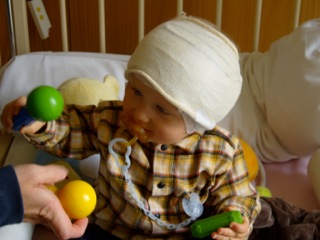 At 8 months Matthieu lost his residual hearing and it became obvious that only a cochlear implant could help him. He was finally bilaterally implanted with 2 Cochlear devices at 14 months in October by the surgeon in Tours (1½ hours away from home). We waited two weeks for activation. Matthieu couldn’t hear a thing, but he was not silent at all. In the meantime, I kept reading blogs and books.
One day before activation I found a professional website dedicated to AVT. Therapists posted tips, studies, and exercises. And, at the bottom of one page, there was a name, and an e-mail address. I immediately decided to e-mail this AV Therapist and ask for help, because I knew that once Matthieu could hear he would need much more than what I had done so far. And I needed a professional to help me.
Why her and not one of her colleagues? Why did I decide to ask for her help at just that moment? Three and a half years later I still don’t know. I explained I was French, and that I needed help to educate my son. Could she please answer a few questions? Give me some tips? The answer came a few hours later: “I am so excited, we can try AV sessions on Skype !” One answer and Matthieu’s life was changed forever!
Matthieu was activated the next day, but our challenges were not over yet. That’s exactly when I started to encounter some resistance, because after the first appointment I met the therapist on Skype for the first time. She explained to me what I needed to ask the audiologist: 20dB on all frequencies within 3-4 weeks. Matthieu was 14 months old and had to catch up quickly. When I said that to the audi, he just stared at me, and calmly said: “20dB? That is unnecessary! Look, 20 dB is a quiet room, Matthieu doesn’t need to hear that. But, we can try to reach 35dB in 10 months.” That left me speechless!
I decided to try another CI center. I called 8 others. All the audiologists gave me the same answer: “Oh sure we could work with your son, but we don’t want to interfere with other professionals and you know 35dB with a Freedom is the best we can do, So you’d better stay where you are.” But at each MAPping session there were disagreements about the goals. I remember telling the audi that Matthieu was not scared when I shouted, and that he didn’t hear the low frequencies with the six Ling sounds, so maybe he was not hearing properly. He answered “why do you want to scare him? And you should stop testing him like that. Your son is deaf, and a cochlear implant will not change that.”
I kept searching for information on the Internet, and I sent an e-mail to a cochlear implant center in London. I wanted to know if they would be willing to program my son’s processors. They gave me an appointment for a whole week-long session in February: 3 months post activation. When the English audiologist saw Matthieu’s MAPs, she just said “hmm, they are unusual.” After one week in London, Matthieu’s hearing was so different. He could hear everything, and he started to babble more and more. When the French CI center discovered that we had gone to London, they decided not to treat Matthieu anymore. Matthieu started talking 6 months post London MAPping, so we kept going to London every 6 months.
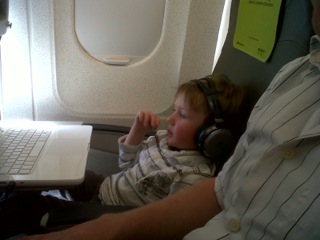 In 2010, almost 2 years after surgery, we flew to Utah for a 6-week auditory verbal summer session, but also for MAPping sessions. When we came back, my little boy couldn’t stop talking both in French and English. The American audiologist made real performing MAPs. Matthieu could hear everything, even from a different room!
In September 2010 our American Skype AVT therapist dismissed my son. After 2 years, he was AV graduated. 2 years when all the French speech therapists told me they would see Matthieu at least until high school. Due to the European financial crisis, the center in London couldn’t keep programming Matthieu’s implants, so we had to find another center willing to follow what had been done in Utah. It’s finally in Barcelona, Spain, that we have found the right place. I tried to contact some other French audiologists, but, we found it was difficult for the French audiologists to accept that we were having the mapping done abroad, and I came to understand that we had found our way onto a “blacklist” – in France the medical community is very small. I knew that a good MAP was essential to Matthieu’s success, so we did what was necessary in order to help him hear his best, even if we had to make financial sacrifices and burn some bridges to get there.
We now go to Spain once a year, and Matthieu participates fully in his sessions. He has more than the vocabulary needed to explain what he hears. He is mainstreamed, and he wants to play piano or trumpet. He is on the way to advocate for himself, and my job as a “speech therapist” is over. I am just a mom concerned with her children’s well-being.
I was once told by a wonderful mother that “the sky is the limit” for our implanted children. But in France in 2012, Auditory Verbal Therapy is still not an option for parents, bilateral cochlear implant surgery is not commonly available, MAPping a cochlear implant in France is a fight, and most audiologists don’t seem to focus on getting the best performance. We still have a long way to go.
Matthieu recently told me that he’d like to build a staircase to climb to the moon to talk to it. I believe he can do it, because thanks to those wonderful people abroad, he has already reached the sky.
While Caroline Pisanne stated that her job was over, of course she continues to advocate for Matthieu. Now that Matthieu is mainstreamed, Caroline is working with the school system to provide Sound Field Systems in the classroom. Read about it here!
MED-EL lengthens US warranty on external equipment
Birding Through Vision and Hearing Challenges
Martha Steele
This article appeared in Bird Observer Vol.39, No.5, October 2011. Reproduced with kind permission.
This is a personal story about my journey through stages of birding defined by progressive vision loss and hearing challenges. I have Usher syndrome, an inherited disease that combines retinitis pigmentosa (RP) and hearing loss. RP is characterized by a progression of night blindness, increasing peripheral field loss (tunnel vision), and finally central vision loss, all the result of the retina’s rods and cones dying off. The rate of vision loss varies from person to person, with some individuals nearly completely blind by early adulthood while others have some functional central vision for life. Hearing loss seems to be relatively stable in Usher, although some progressive loss occurs.
I was diagnosed with severe hearing loss as a young child and have worn hearing aids since I was about four or five years old. But through my early adult years, I did not realize that I had any significant vision issue. I could not see well at night, but it seemed normal to me until a day in Colombia, South America, where I was teaching at a junior high school. Two friends noticed how often I bumped into things and wondered why. One friend spread her arms wide apart and gradually brought them closer together, asking me to stare at her face and tell her when I saw her hands out of the corners of my eyes. Her hands were practically touching before I saw them. At that point, we knew something was wrong.
When I returned to the US, I saw an ophthalmologist in my home state of Vermont. He came into the examination room after a series of tests, looked at my retina, sat back, and said, “I think you have retinitis pigmentosa. You will be blind in ten years, so I would advise that you not try to be a truck driver.” Ok, bad news, really bad news (about going blind, not the truck driver part), stunning and devastating actually. That was back in 1977. I learned shortly after his blunt diagnosis that the vision loss would be much more gradual and that I could expect reasonably good central vision for many years.
Fast forward to May 1989. My friend, Martha Vaughan, was leading early morning bird walks in Mount Auburn Cemetery for anyone at our work place in Cambridge who cared to join her. I showed up for one of her walks without binoculars, of course. She had an extra pair. I have a distinct memory of Martha walking through the front gates, and immediately raising her arm to the sky and exclaiming, “A parula!” I didn’t hear the parula nor any other bird, only her and other birders’ excitement at all of the songs filling the early morning air. However, I saw warblers, lots of warblers, and I was hooked. I asked Martha where I could get binoculars, and I opted for 10 power Zeiss binoculars because I wanted to see as well as possible, given my vision issues.
Early in my birding avocation, I had good central vision, so I could see birds well if I managed to get binoculars on them. But I could not hear most birds due to their high-pitched vocalizations because my hearing loss was particularly acute. A few species, such as Mourning Dove, have lower-pitched vocalizations that I could hear. I always marveled at the ability of birders to identify birds by sound, a totally unimaginable and unreachable experience to me.
 Images depicting visual impairments
My birding strategy was to walk behind other birders, waiting until they stopped and raised their binoculars in a certain direction to find what they heard or saw. I stood behind them, looked in the general direction they were looking, and tried to see some movement before bringing the binoculars up to my eyes.
As the years went by, this strategy worked less and less as my vision continued to decline. My peripheral field became more and more narrow, making it increasingly difficult to detect movement of small, distant birds. I tried to contain my frustration at not being able to locate a bird despite everyone’s best attempts to describe where the flitting bird was. I relied more and more on someone, most recently my husband, Bob Stymeist, getting the bird in a scope.
Today, I can’t recognize faces five feet away, never mind a dark bird on a dark branch in a dark understory 25 feet away. Going blind may be one thing for a birder, but it is even more challenging for me because I never could hear the birds either. So why do I bird? The simple answer is that the birds are extraordinarily beautiful and I am constantly profoundly moved by their ability to survive, whether during migrations over thousands of miles or finding habitats sufficient for their needs. I cannot look at a Blackburnian Warbler and not say, “good luck, little fellow” or a Black-throated Blue Warbler and not marvel at its beauty. But one thing I never could enjoy was bird song. Until now.
I would walk behind Bob, who barely looked up from the ground, and wonder why isn’t he looking around to find birds? Suddenly, he would stop and locate what he had just heard. Or sometimes he would simply pull his notebook out, write down “CAWR,” and move on, never missing a beat. I always thought that strange, though I was well aware that birding is largely by ear.
With the continuing decline in my vision, I decided to explore whether I should get a cochlear implant, not for bird songs, but to better understand speech. Hard-of-hearing people use lipreading extensively to help them understand what is being said. I can no longer see well enough to lipread, so I knew I would lose more ability to understand speech, a sort of double whammy. After a lot of research, encouragement from other cochlear implant recipients, and evaluations at the Massachusetts Eye and Ear Infirmary, which found me to be eligible to receive an implant, I took the plunge.
The surgery involves drilling a small hole in the mastoid bone of the skull directly behind the ear and inserting an electrode into the cochlea, or inner ear. Then, an indentation is made in the mastoid bone to set the main receiver of the implant on the skull before the incision is closed up. The external component, the processor, is like a minicomputer that can be programmed and updated with new software as technology improves. A wire extends from the behind-the-ear processor to a magnet that attaches to the internal receiver. Sound is received by the microphone in the processor, digitized, transmitted via the wire/magnet to the internal receiver, converted to electrical impulses, sent to the electrode, and the electrical impulses are then sent to the auditory nerve, which goes to the brain.
The surgery usually destroys all residual natural hearing in the implanted ear, leaving one completely deaf in that ear. So, the decision to do the implant cannot be taken lightly. There is no guarantee that one’s hearing will be better after the surgery than it was before, and indeed, it may be worse. But I knew my hearing was getting worse anyway, and I knew with the declining vision, this would become more problematic with time, so the choice in the end was clear.
On April 9, 2010, I had surgery for a cochlear implant in my right ear (the left ear continues to have a hearing aid). The surgery was a day surgery. Forty-eight hours later, the bandage came off, and I was back at work in a week. On April 29, the implant was activated.
When the implant was first activated, everything sounded the same and very tinny or high-pitched. I couldn’t decipher distinguishable words. It takes time and practice for the brain to learn the new sounds and for the tinny sounds to eventually become words and then sentences. Within a couple of weeks, I could understand speech vastly better than before the implant, and time would only show continuing improvement. The implant enabled me to hear, for the first time, many consonants that are high-pitched and beyond many hearing-impaired people. I could actually hear the difference between Chicago and change; tap and map; go and toe.
What I did not bargain for was BIRD SONG. I was stunned, absolutely stunned, by the fact that I was hearing birds everywhere. Not just a little, but a din of bird song. How have you all put up with House Sparrows all your birding lives? They are so annoying! I had never heard them. How were you able to tell the difference between a Red-eyed Vireo and a Blue-headed Vireo, a Scarlet Tanager and an American Robin? To my computerized sense of hearing, these are still challenging, but I think I am getting a little better at it.
Just imagine if you could not hear bird songs, how much more difficult and perhaps less enjoyable birding would be for you. I now know how you might feel. Not long after my implant was activated, a Kentucky Warbler showed up at a small park near Boston College in Chestnut Hill. Bob and I went over to try to see it in the early evening hours on a weeknight. We were alone in a small oasis of dense vegetation, tall trees, small ponds, and thick underbrush looking for the bird. Then it started singing. The song echoed in the forest, sublime, melodic, and all encompassing. I couldn’t move. I didn’t care to see the bird. I only wanted to stand there, close my eyes, and listen. For those of you who know me, you can probably guess what happened next. Yes, I cried. Birds, especially the little songbirds, have a tendency to move me to my core, but the added dimension of hearing them left me feeling overwhelmed with joy.
Since then, Bob and I have gone on many walks as I try to learn the songs with this bionic ear. I am hearing songs while the car is moving at 40 miles per hour; I am hearing them from some distances; I am hearing them when songs are on top of each other; and I am hearing songs that some of you, because of age, perhaps can no longer hear, such as the Brown Creeper, Blackpoll Warbler, Blue-gray Gnatcatcher, or Golden-crowned Kinglet. Every time I hear a Northern Parula, I am reminded of that first image of Martha raising her arm to the sky, as I, too, raise my arm and, for good measure, do a little hop, to give body language to the song’s rising zeeeee-up
In June 2010, Bob and I visited Ed Neumuth in Washington, Massachusetts, for a wonderful visit and day of birding at October Mountain. We got up at 5:00 a.m. and Ed was the expert guide for a tally of 76 species, including Mourning Warbler, which I caught a brief glimpse of. But what I most remember about that day, and probably always will, was a moment when a Winter Wren was singing its heart out very close to the road. As we stood there marveling at its song, Ed related the story of a birding friend who was dying of brain cancer. His friend wanted to go birding one last time. Ed took him to October Mountain. They were stopped at one place when suddenly a Winter Wren perched on a bare branch just yards directly in front of them and started singing. The bird sang for several minutes, and the men were mesmerized. When it flew away, Ed’s friend turned to him and said, “Let’s go home now; nothing can top that.”
Nothing can top what the cochlear implant has given me. I can walk in the woods looking down at the ground—like Bob and all of you—and know that it is quiet or know that a Black-throated Green just sang. I am satisfied, deeply satisfied, to just hear the bird. I feel no urgency now to see the bird, and perhaps strangely, no particular loss at not being able to see most birds any more. It is the song that now gives me immense joy, it is song that now enables me to more deeply share my passion for birds with Bob and my birding friends, and it is song that now connects me to the birds that I love. Yes I, too, was mesmerized by the beautiful song of a Winter Wren on October Mountain. Good luck, little fellow.
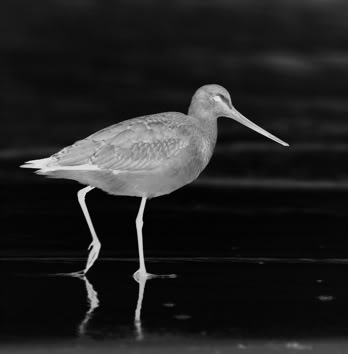
Hudsonian Godwit by David Larson
Martha Steele is a past editor of Bird Observer and lives in Arlington with her husband, Bob Stymeist. She is a native Vermonter, and she and Bob frequently bird the Northeast Kingdom of Vermont, including competing in the 2011 Vermont County Quest (sponsored by Birds&Beans) for most bird species seen in specific counties (in their case, Essex, Orleans, and Caledonia counties). Martha has spent most of her professional career at the Massachusetts Department of Public Health. In addition to birding, she volunteers in the Boston chapter of the Foundation Fighting Blindness and serves as the chair of the October 29, 2011, Boston VisionWalk. Martha and Bob’s team, Strides for Eagle Eyes, has raised nearly $60,000 for research on blinding diseases since 2009.
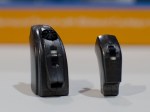
Spy photos – T-Comm
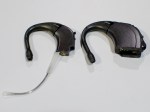
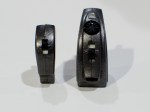
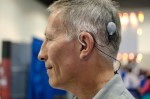
The T-comm for Neptune will be available later this summer, but cochlearimplantHELP has grabbed some spy photos at the HLAA convention. For size comparison, it is shown next to a Harmony processor.
Cochlear Implant coffee mugs
 Our good friend and neighbor made a wonderful coffee mug with a CI processor for a handle. Now you can order your own custom CI mug from her on Etsy!
Just Announced!

MED-EL has officially launched HearPeers, an online community website that enables MED-EL implant users to interact and share their experiences with each other. For more information visit HearPeers.
Advanced Bionics has released an iPad app “Build myNeptune” to create your own custom Neptune sound processor. For more information visit iTunes.
 cochlear implant HELP