
(CNN) — In an agreement that the National Association for the Deaf (NAD) calls “a model for the streaming video industry,” Netflix has agreed to caption all of its shows by the year 2014.
Author Archives: CochlearImplantHELP
Cochlear Aqua Accessory Review
The Cochlear Aqua Accessory is now available in Canada, and your team at cochlearimplantHELP.com has acquired a box of 30. CochlearimplantHELP is proud to present the world’s first review of the Aqua Accessory!
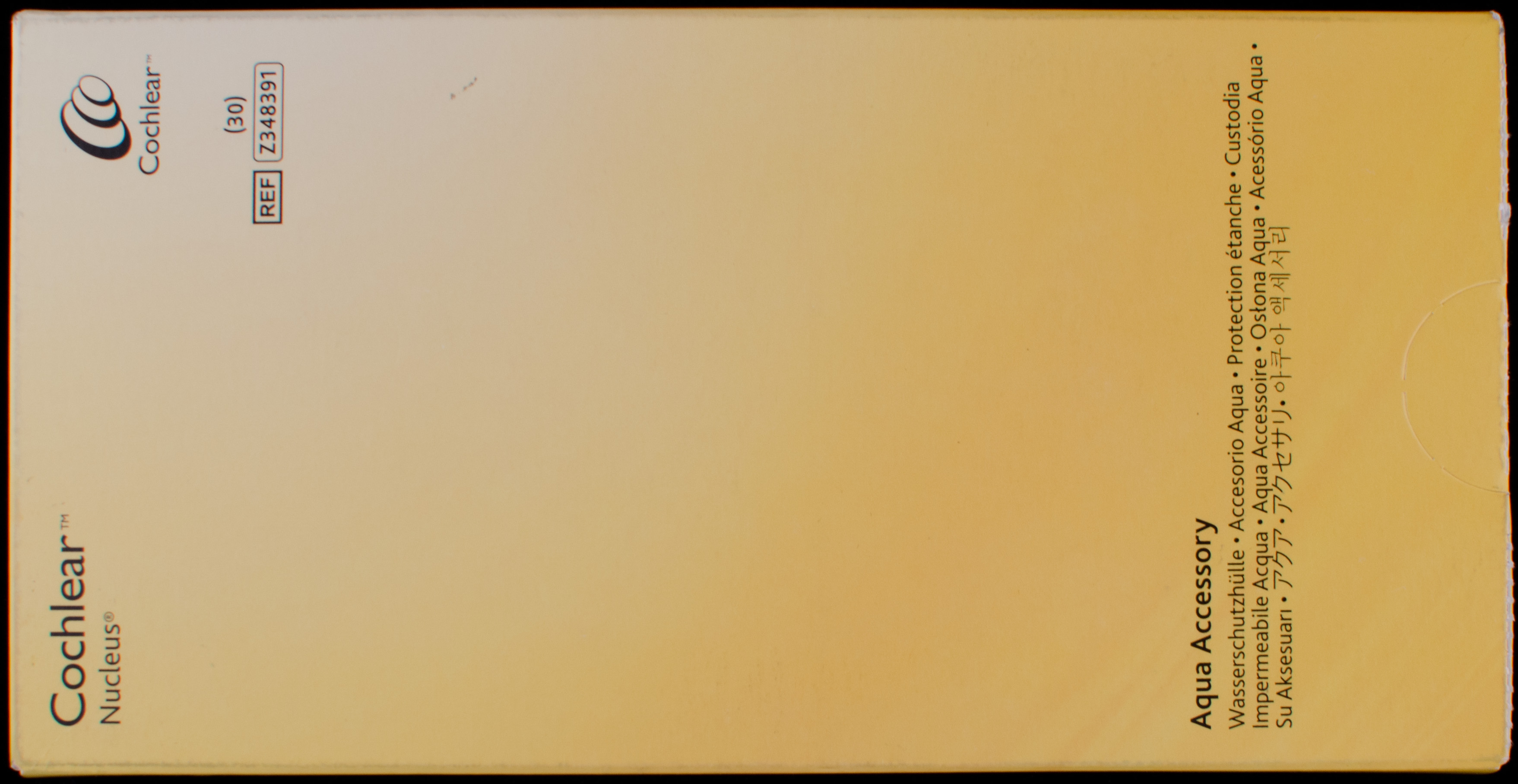 The box has an easy-open thumb tab with perforations. Slide the drawer out for a summer of aquatic fun.
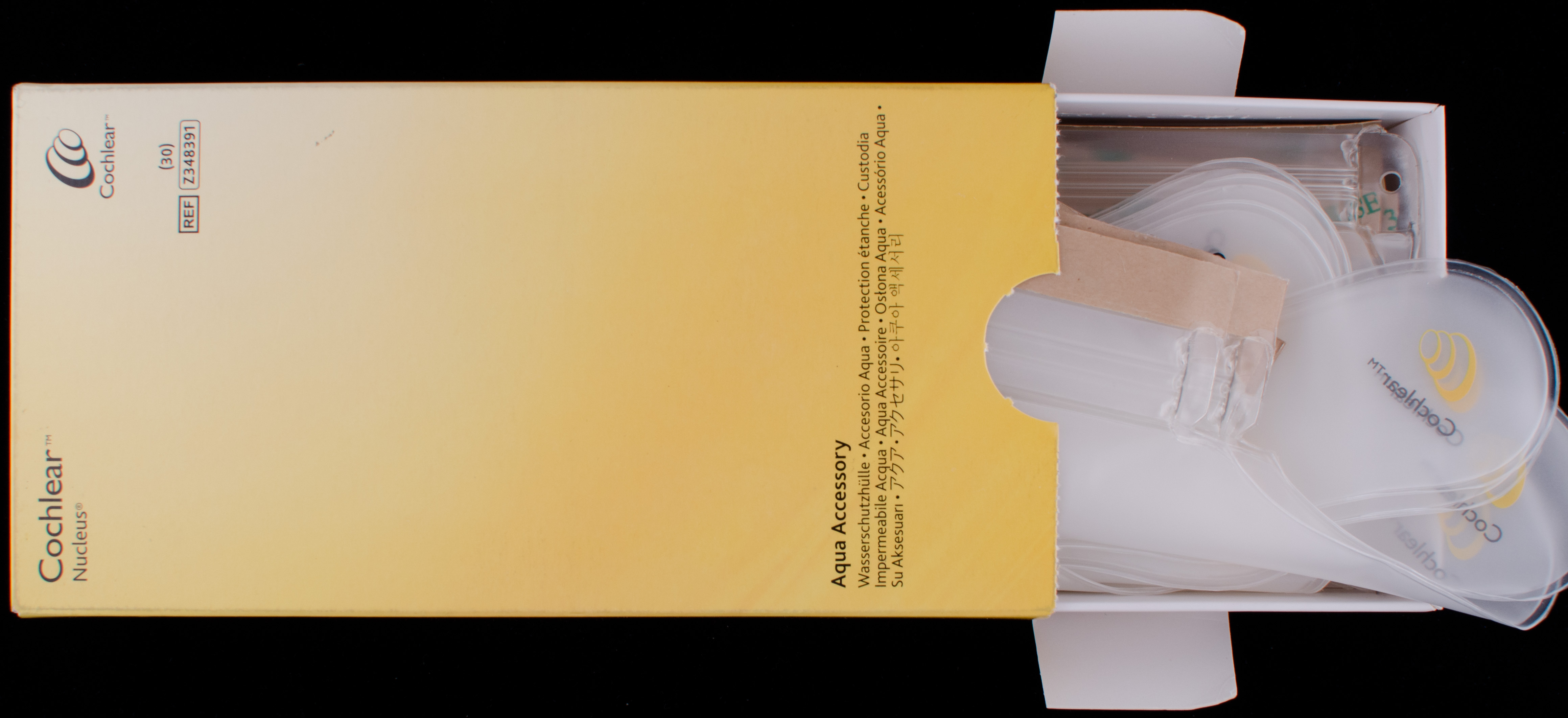
The Aqua Accessory itself (c’mon, Cochlear is great at coming up with names, how about something more catchy for this?) is made of a very soft plastic. The closure works like a Ziploc® bag, but the plastic is much stiffer. Be careful when you open it. It is easy to get the wrong side of the closure and rip the soft plastic part.
The manual shows graphically how to use the Aqua Accessory. Insert the headpiece cable first, followed by the body of the processor. Seal the closure, then peel the tape off and fold over the sticky flap. The headpiece extension is long enough to accommodate users whose headpiece is very far away from the ear. Most users will find that the headpiece is closer to the ear than the maximum distance. The soft plastic folds nicely to accommodate a wide range of headpiece locations.
Inserting the processor is definitely best done by parents. The combination of potential rips when opening the Aqua Accessory, plus the difference in stiffness between the closure and the bag, make it difficult even for an older child to follow the procedure correctly.
Step 7 instructs you to surf, swim, shower, windsurf, waterski, and go sailing. It may not be necessary to participate in all of those activities each time you use an Aqua Accessory. But it certainly would be fun to try!
It isn’t clear from the instructions if you are supposed to wear a swim cap, as in the photo of step 7. If you don’t wear a swim cap, it seems that the whole assembly would fall off pretty easily.
The last page of the manual shows a clip to secure the Aqua Accessory to a collar. The clip is not provided in the box. Since this sort of clip isn’t readily available, Cochlear should provide one! A swim cap is probably sufficient, but a clip will provide extra security.
The owner’s manual says: “Use of this product will not affect your Nucleus Global Limited Warranty. Your Nucleus Global Limited Warranty will not be void in circumstances where the Aqua Accessory is used in water with a CP800 series sound processor only, in accordance with the Aqua Accessory instructions.”
Presumably this means that the processor is covered for water damage. But the processor manual does have limits on what is covered for water damage. Hopefully this will be clarified, and the company will warranty any water damage at all when using the Aqua Accessory.
The Aqua Accessory is large enough to accommodate an Advanced Bionics Harmony processor, currently the largest BTE processor on the market. Presumably it can also handle MED-EL OPUS processors.
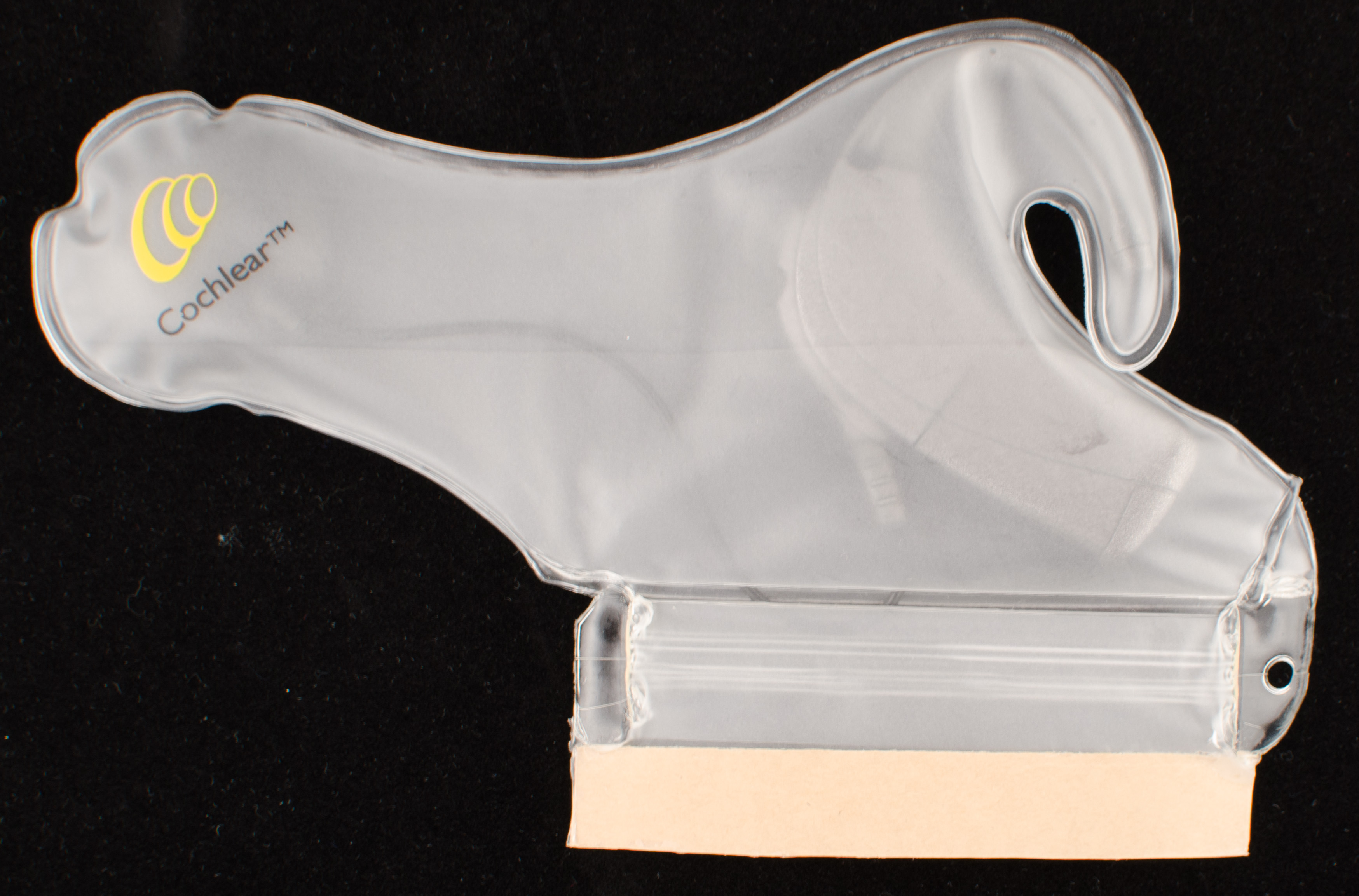
This configuration includes the adult size T-mic and the PowerCel Slim battery. Notice that the headpiece cable makes a rather sharp turn shortly after exiting the processor.

My headpiece is at about an average distance from my ear. The Aqua Accessory must be folded for the headpiece to fit over the internal magnet. The added thickness of the bag does weaken the magnet strength a little bit. You may want to add a magnet, but the swim cap is probably sufficient to hold it all together.
The inside of the earhook is a potential region for irritation. It doesn’t hurt when worn for a short period, but it is definitely noticeable, and may cause some soreness if worn all day at the pool or beach. You should probably check your child’s ear for redness frequently until you are comfortable that it is not a problem.
When wearing the processor in the Aqua Accessory, the sound is slightly muted, almost as if you are underwater already. But it is a small price to pay to be able to hear while swimming! The change in sound quality will probably not be noticeable after wearing it for a while.
The instructions specify that the Aqua Accessory is a single-use item. It seems to have been designed to enforce that. Unless you carefully cut the fold-over flap, the only way to get the processor out is to rip the plastic open. As shown in figure 8, start at the notch at the very back of the Aqua Accessory, and rip it just enough to be able to extract the processor carefully.
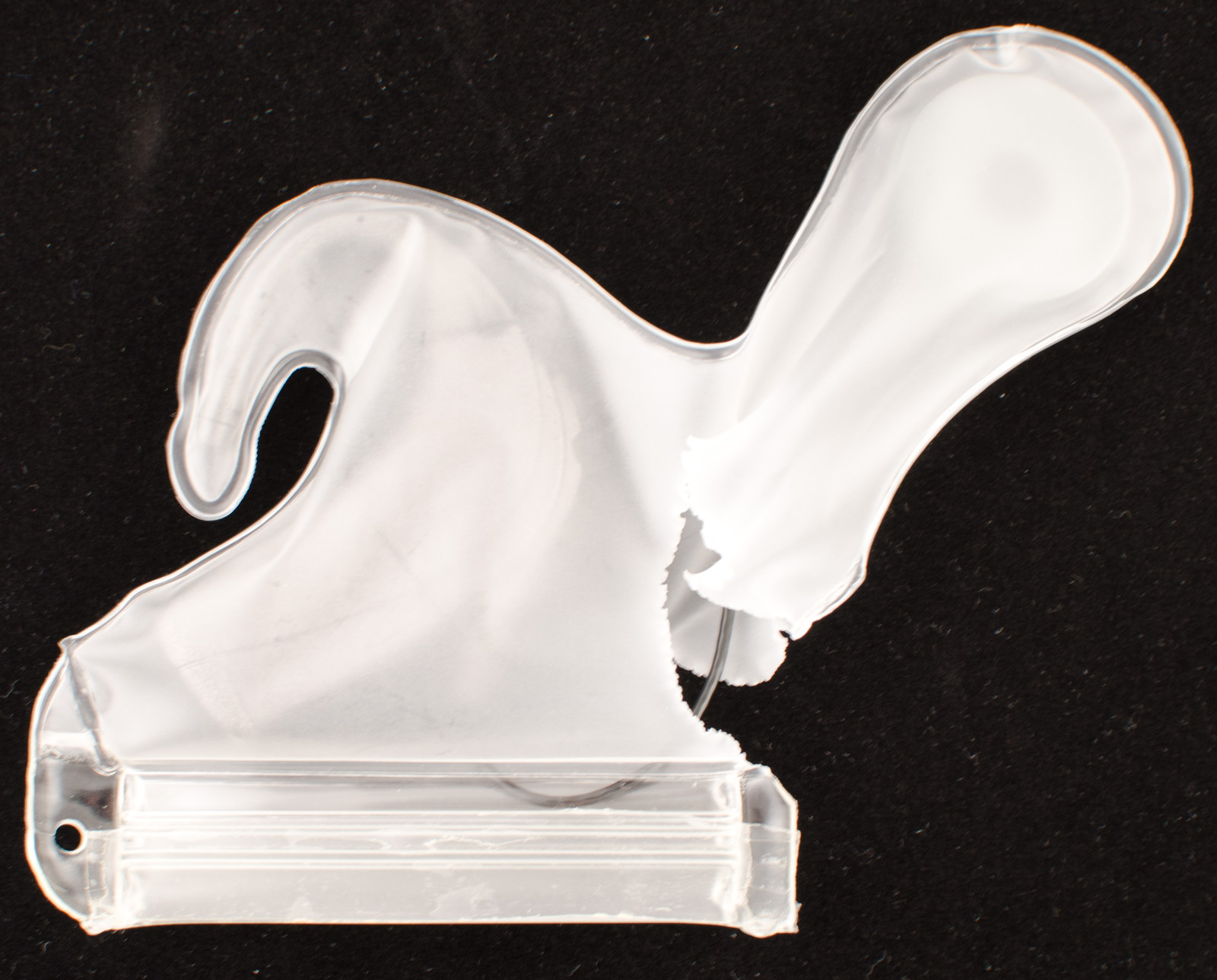
Again, this is probably best done by parents.
The Aqua Accessory will definitely allow kiddos to swim with friends and to take swimming lessons. It is a bit of a procedure to set up, and you really do need the swim cap all the time. While it may be fun to try in the bath a few times, it probably won’t become part of the daily routine.
As of the time of this post, the Aqua Accessory is available only in Canada. Check with your local audiologist or with Cochlear to stay informed on when the Aqua Accessory will be available in your area. CochlearimplantHELP does not sell anything and cannot provide Aqua Accessories.
Cochlear Celebrates 30 Years
Image
Volunteering for Cochlear Implant Testing
 Have you ever wondered where new stimulation techniques are developed and tested? Or how manufacturers try out new hardware and software to see if improvements can be made in terms of hearing performance or device usability?
Would you like to participate in some of these experiments?
Learn about all of this at Volunteering for Cochlear Implant Testing! We are starting with just a small selection of the premier research labs in the world. If your local research facility would like to be added to our list, please let us know by clicking on the Contact link above.
Cochlear HOPE Words App for iPod and iPhone
Cochlear announces a new app to improve listening and spoken language skills of children with hearing loss. Look for it in the iTunes store today!
Cochlear introduces Aqua accessory
Cochlear has introduced the Aqua accessory that allows you to swim or shower with your BTE processor. Read more about it here!

More data supporting bilateral implants
Another study has been published describing the benefits of bilateral implants. This may help you with your decision to have a second implant, and you may be able to use it as part of your argument for getting the funding in place for the implant. Read about it here!
Choosing a Cochlear Implant with Usher Syndrome
Martha Steele
How a cochlear implant helps me cope with progressive vision loss
This is part two of a series. View part one here.
 Over the following months, I had a comprehensive evaluation to determine my eligibility for an implant This included interviews with a surgeon, a social worker, an audiologist, and an academic researcher. The latter had the job of telling me everything that could go wrong, including the fact that my hearing might actually be worse after the surgery than before. I exchanged several emails with this researcher and finally concluded that his caution was appropriate but that he also seemed optimistic that the chances of success were at least better than average. At the same time, I began talking to CI recipients, attending seminars and exchanging emails with other cochlear implant recipients, including a few who also had vision issues.
I felt supremely confident in my surgeon and did not worry about the surgery itself. I was nervous about how effective the CI would be, knowing that if it was not an improvement, I could not turn back, as the surgery may damage residual hearing. Still, I thought the likely benefits outweighed the risks, and I decided to take the plunge.
 I was activated in late April 2010. The initial sounds were very similar to one another and very tinny. I couldn’t understand a word, but oh my, was I hearing! That first day, I was hearing consonants that I had never heard before. And to me, it was those consonants that made so much of a difference in speech understanding.
It has now been over two years since I was activated, and I still wear a hearing aid in the other ear. The CI has been a stunning success, exponentially improving my ability to understand in all situations, including noisy environments. It is not perfect, as I still struggle in very noisy restaurants with people sitting across the table from me. But so much has improved at a time that I most needed help, at a time of losing my ability to see faces and, more specifically, lips. Only six months after I was activated, testing in a sound booth of single syllable words revealed that I correctly repeated 85 percent of the words and was nearly correct on the remaining 15 percent. My audiologist was ecstatic, as was I. I am no longer hesitant to attend large meetings, no longer hesitant to ride in the back seat of a car with people who no longer have to turn to face me when they speak, and no longer hesitant to address questions from an audience in a large room. I can hear the difference between the “ch” of Chicago and cheat. And best of all, I can hear and identify bird songs, something that has restored so much of my enjoyment of my passion, birdwatching.
The next big question for me is whether to go bilateral and get a second CI. That is a leap that I have found challenging to take. I find the CI and HA complementary: the CI picks up the high sounds, the HA the low sounds. The HA enables me to enjoy music with natural, though amplified, hearing; I find music with the CI still very mechanical sounding. Given that my understanding has been so good even with just one CI, the added benefit of a second CI for speech understanding alone is not very clear to me, especially in light of the likely loss of all hearing in either ear.
 However, my continued decline in vision may once again be a factor in my decision on whether to go bilateral. I am more and more reliant on auditory cues to help navigate the world. Street crossings often involve hearing the buzz of a walk signal, the direction of traffic flow, and the speed of vehicles approaching the intersection. I find myself turning my head so that the CI ear is positioned best to listen for the auditory cues. I also often position myself in other situations such that I favor the CI, such as having someone sit to my CI side to better understand. Do these conscious maneuvers mean I should be considering a second implant? Would a second implant enhance my safety? Clearly, I need to consider this decision more now than ever before.
For now, though, this CI never ceases to amaze me and I never take this gift for granted. It was clear that I was struggling more and more as I lost central vision acuity, and the CI has made coping with the vision loss so much more manageable. It has dramatically improved my hearing experience in all types of environments; it has allowed me to know that I can pursue my passion of birding for a lifetime despite my vision loss; it has given me more confidence to interact with people I don’t know without being worried about missing important conversational pieces; it has simply made a profound difference in my life.
There is a similar device recently commercialized in Europe for people with total loss of sight. The retinal implant operates similar to a cochlear implant in that electrode excite the optic nerve to enable the recipient to see something. For now, this implant gives little more than shapes and shadows where total darkness had been, so it is not appropriate for everyone with vision loss. It reminds me of the early days of the cochlear implant, when the first recipients had to carry around a suitcase of wires. Over time, of course, the technology improved and the CI provided benefits to more and more people with the improved technology. I expect similar and rapid advances in retinal implant technology. Perhaps one day, that technology will help me sport a bionic ear and a bionic eye! In the meantime, I continue to be stunned by the CI experience and may well opt to go bilateral, especially if having two CIs will significantly improve my safety navigating the world. That is my next decision and my next challenge.
Growing up with Usher Syndrome
Martha Steele
How a cochlear implant helps me cope with progressive vision loss
I have Usher Syndrome, a genetic disorder characterized by a combination of severe hearing loss and retinitis pigmentosa (RP), which causes blindness. Usher Syndrome is the leading cause of deaf-blindness in the U.S. RP typically manifests itself initially by poor night vision evident in childhood, then increasingly narrower peripheral field, and finally worsening central vision.
Usher Syndrome can occur with different degrees of severity. Type 1 is characterized by profound hearing loss at birth and severe balance problems. Type II is characterized by moderate to severe hearing loss and no balance problems. Type III patients have normal hearing at birth, with hearing loss occurring later in life. In all three types, RP occurs, with Type I patients typically losing their vision more quickly than the other types.
I was diagnosed with hearing loss when I was about four or five years old. My mother tells me the story of driving a car with a friend in the front seat and me in the back seat. Her friend noticed that every time Mother spoke to me, whether moving or at a stop, she turned her head to face me before she spoke. Not long after that observation, my parents took me to an audiologist for a hearing test.

I was fitted with hearing aids (the kinds worn in pockets with a wire up to the mold in your ear), and attended first grade at a special vocational school 60 miles from home. That year was heart wrenching for my parents, as I had to live during the week with a foster family. But it proved to be life changing, teaching me the necessary skills to cope with severe hearing loss and to catch up to my peers in verbal communication skills. Among the skills that I learned and became highly adept at was lip-reading.
I returned to mainstream schools in the second grade and went on to do well academically and athletically throughout my academic career. I was totally unaware of any vision issues through high school, although I did know that my night vision was not as good as that of my friends and family. Nonetheless, it wasn’t that bad, and I could easily drive at night during those years.
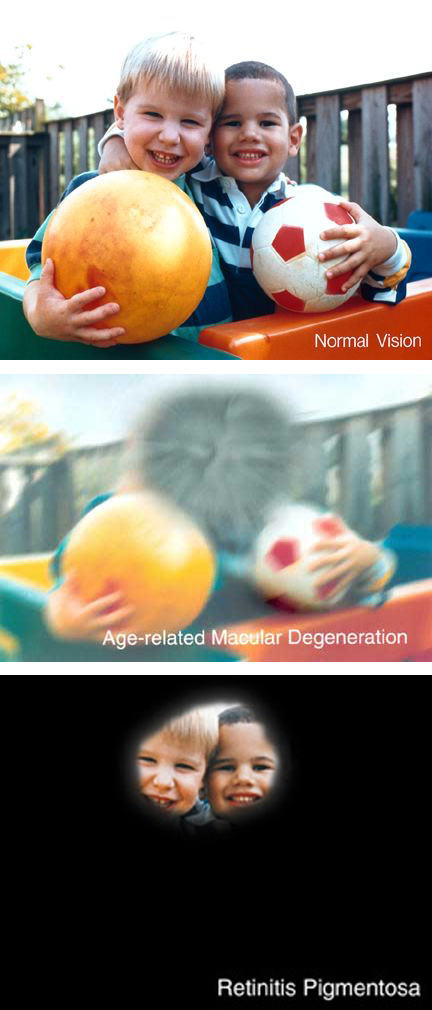 It was not until I was 25 years old that I was diagnosed with RP. By then, my peripheral field had narrowed to the point that I was often bumping into things out of my field of vision, such as fire hydrants, chairs, little children (yikes, I got some hostile looks from parents!), and other objects. Although devastating news, I soon learned that the decline in vision would be gradual and that I could expect decent central vision for many years. So, in a sense, I put the diagnosis in my back pocket, and moved on.
In some cases of Usher Syndrome, early degeneration of the cone cells in the macula leads to loss of central acuity.
Eventually, the narrow field resulted in my being declared legally blind by the time I was 30 years old. In 1984, I stopped driving cold turkey. I was in a busy mall parking lot with few of the typical rules of the open road and had several near misses for fender-benders or pedestrian nudges. I knew then that I was not willing to risk hurting anyone as a result of my visual limitations.
 Hearing aids have been a part of my life and have served me well navigating through life. I don’t recall much difficulty in classrooms understanding teachers, nor do I recall difficulties hearing coaches and teammates during various athletic competitions. I did rely heavily on lip-reading to help me understand what I was hearing, and I relied on other visual cues to help me understand the surroundings, context, and meaning. It does not appear that Usher Syndrome, at least Type II, results in a similar progression of hearing loss as it does with vision loss. Still, as I got older, I noticed more difficulty in certain situations, perhaps as much because of the aging process as anything.
But what really began to affect my ability to understand speech was the gradual loss of being able to lip-read as my central vision began to worsen. This started happening about five years ago, when I was 55 years old. At that time, I could read easily, I could shop easily, I could see faces easily, and I could watch television easily. Within a year, all of those things were notably more difficult, and today, I cannot do any of them without assistive technology or someone’s help, if at all.
Losing vision of course means that I cannot read lips any more, and losing that ability means my speech understanding was significantly affected. I noticed a few years ago that I was having more and more difficulty understanding people at large work meetings, where someone at the other end of the table was virtually impossible for me to understand. I began avoiding situations that had before posed no issues. I said “What?” much more often than I could ever remember, even in a quiet conversation at a dinner table. I was more and more reluctant to try restaurant settings, cocktail hour events, riding in cars with anyone I didn’t know very well, or representing my employer at public meetings. I was lucky that as my difficulty in understanding declined, my employer adjusted along with me, not requiring my presence at certain meetings that I used to attend regularly.
It was obviously time to seek some assistance. My first attempt was to use FM systems to enhance one-on-one conversations, as well as the ability to converse in noisy environments. These systems are very, very good for one-on-one interactions, especially in noisy environments, but they are not ideal in a group situation. You simply cannot easily pass a microphone around a room, or around a dinner table, it is just not feasible and I found quite awkward. We tried different types of attachments that would set a microphone up in the middle of a group of people, but invariably, most people would not speak loud enough for the microphone to adequately capture sound.
This was definitely becoming a problem. It’s hard enough to start down the path of shadows or darkness, but to also cope with increasing difficulty understanding speech was a double whammy. In the spring of 2009, I attended a seminar in the Boston area geared toward the Usher Syndrome community. During the session, an ENT physician casually mentioned as an aside that cochlear implants were becoming more available as eligibility criteria for them were rapidly evolving. My ears perked up, and I sought the physician out after the meeting to talk to her. She urged me to make an appointment with my ENT physician to discuss a possible referral to cochlear implant specialists. That was the beginning of the rest of my life.
To be continued…
Cochlear Failure Rate Remains Steady
According to the FDA database, the CI500 series implants continues to experience an elevated failure rate. The FDA database is updated periodically, often with additions including delayed reporting of incidents. The latest charts are available here.
 cochlear implant HELP