Syndicated cable TV host Loleata Wigall interviews CochlearImplantHELP’s Howard Samuels about cochear implants on her show ‘Let’s Talk About Hearing.’
Syndicated cable TV host Loleata Wigall interviews CochlearImplantHELP’s Howard Samuels about cochear implants on her show ‘Let’s Talk About Hearing.’
By Katie-Louise Bailey I had the opportunity to try it out the new AquaCase at the Advanced Bionics Family Fun day at Centre Parcs, Nottingham, UK. Before trying the AquaCase, I had already experienced hearing in water using my very own lime green Neptune. Hearing in water makes swimming so much more fun. You’d be surprised at all the sounds you’ve been missing if you have not heard while swimming before. You won’t want to go swimming without it!
Holding the AquaCase in my hand, I can see the best things about it. The AquaCase is clear, slim and small. It’s not too bulky. And it looks very secure. Parents won’t have to worry about their child’s Naída CI Q70 breaking or getting wet. They’ll have peace of mind since it is especially made to protect children from opening it. Even me… It took me a while to open it. It’s a bit like a child lock in the car. With a little practice it becomes much easier to open.
I wear a Naída CI Q70 every day. And only tend to wear my Neptune for swimming and for backup if my current processor breaks. Do you ever worry about breaking your processor? I do all the time. It’s like your lifeline. As soon as it hits the floor – the first thing comes to mind is does it still work?
 The AquaCase is shockproof, so it protects the processor if you drop it. It still works. So if you fancy going down the waterslide or do any rough activity you’ll have a worry-free experience. The AquaCase may even be stronger than the Neptune!
The AquaCase goes with anything. There are multiple wearing options, from clip, to lanyard and armband. I prefer to wear it on my armband just like my Neptune. I wear it with a 15 inch cable. You can easily clip it to your bathing suit. Men may prefer to clip it onto the armband.
Wherever you go you don’t have to change processors from Naída CI Q70 to a Neptune to go swimming. You can just wear your Naída CI Q70 anywhere. Just make sure you have the case with you. You don’t need to put it in a plastic bag, which could affect the sound quality. The AquaMic and the AquaCase are both 100% waterproof.
Placing your Naída CI Q70 In the AquaCase is pretty simple too. You don’t need to change the ear hook or anything. Just make sure you have the 110 battery and of course the right microphone. You can easily tell the difference between the AquaMic and the normal UHP headpiece.
The AquaCase and the Neptune have similar wearing options, and the same sound quality. As for the AquaMic – to have the best experience in any activity I would suggest that you make sure to have the right magnet strength so you don’t have to worry about it falling off. It took me about 2 swimming session before I determined the right strength. Now I dive into the water and it doesn’t come off at all! I use two magnets inside the AquaMic, which is enough for my long, thick hair.
 I’ve used both the AquaCase and Neptune in lots of watersports and other sporting activities. If I had to choose between a Naída CI Q70 with an AquaCase or a Neptune, I would choose the Aquacase. You don’t have to keep changing devices. And the AquaCase turns the Naída CI Q70 into a Neptune, so you can feel secure in wet or dirty environments, or even just for rough sports or amusement parks.
I’ve broken the Neptune cover one or two times – I’m very active! The AquaCase seems even stronger, and I don’t think it will break. I’ve worn it playing football, and on waterslides, and it held the processor very securely, even though it was bumped many times.
My advice is that you hand dry the AquaCase before opening it, so that all the water is off before the processor comes out. When you use the Naída CI Q70 in the AquaCase, you should also put the processor and the AquaMic in the dry box over night.
About the Author
 I’m 26 years old, profoundly deaf since birth due to genetic causes. I was meant to get a cochlear implant when I was 7 but my parents decided against it because cochlear implants were still quite new then.
I had a life-changing operation when I received my cochlear implant at age 19. After being implanted It took a lot of practice to be able to understand all the new sounds. I now use my voice practically all the time. People call me a chatter box! I love music, which never even interested me before.
I really would love to go bilateral. Here in the UK, the National Health Service only allows children under the age of 19 to go bilateral.
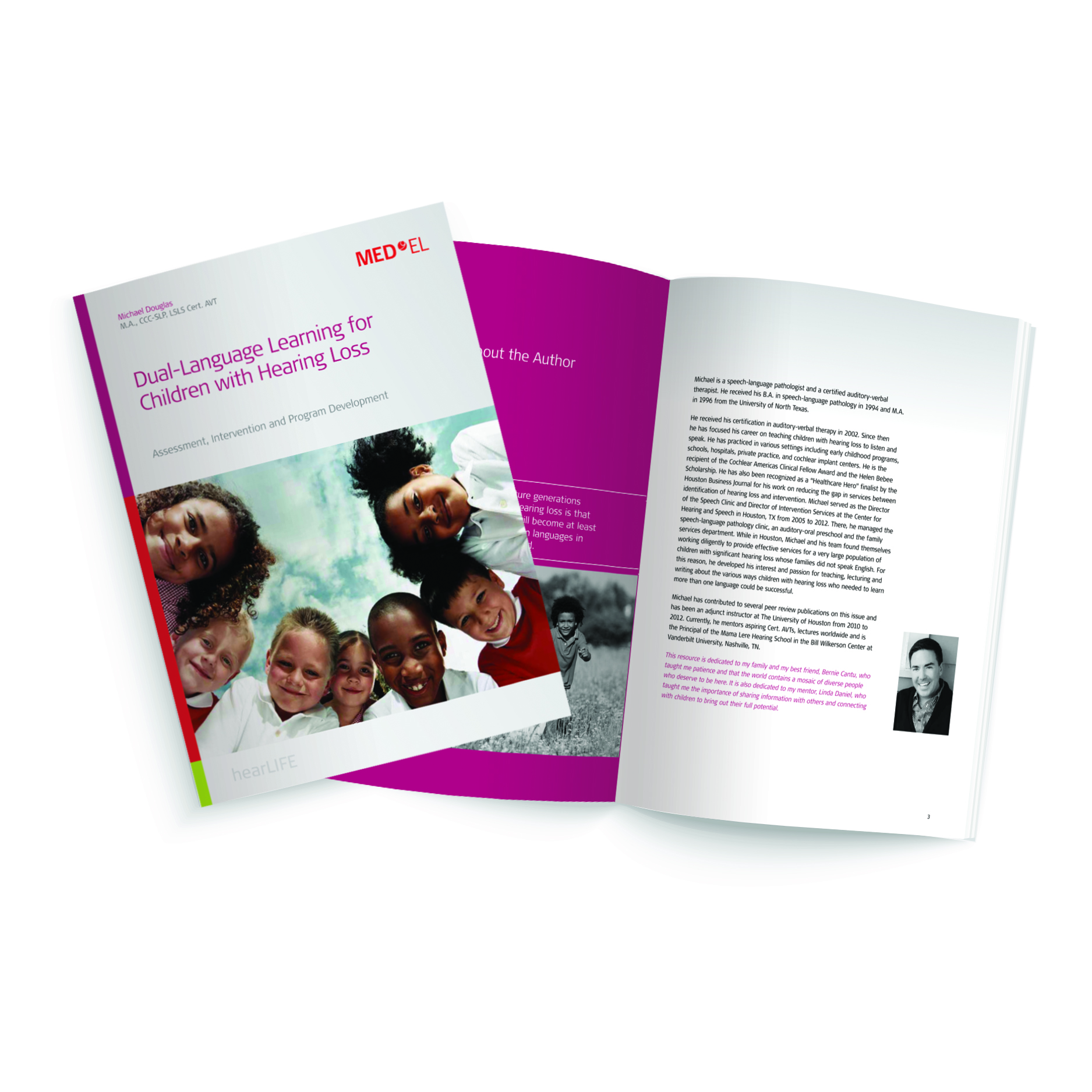 MED-EL USA announces the launch of the first-ever book for speech and hearing professionals and families of children with hearing loss who speak more than one language, Dual-Language Learning for Children with Hearing Loss, by Michael Douglas, M.A., CCC-SLP, LSLS Cert. AVT.
“Increasing numbers of hearing and speech professionals are finding themselves working with children who have hearing loss and come from linguistically diverse backgrounds. Clinicians may be faced with the challenge of helping families who do not speak the majority language,” said Douglas, who is currently Principal of the Mama Lere Hearing School in the Bill Wilkerson Center at Vanderbilt University, Nashville, TN.
Research has shown that encouraging minority language development neither impairs a child with hearing loss nor prevents him or her from learning the majority language in the presence of adequate speech perception and an effective immersion process. As long as a child with hearing loss can demonstrate adequate speech perception within the first few years of life using the latest hearing technology, families can take advantage of their child’s critical learning period with the help of appropriate identification and special intervention procedures to develop bilingualism.
“We now have, more than ever, a unique opportunity to improve services for families who do not speak a majority language or speak more than one language and want a bilingual outcome for their children with hearing loss. I hope this book helps professionals enhance their practice and even inspire others to contribute to a much needed body of resources on this topic,” Douglas continued.
“MED-EL is proud to have published this important resource for speech and hearing professionals who work in diverse and multicultural settings. Dual-Language Learning provides both the knowledge and tools for practitioners to have a successful experience, even if they speak a different language than their clients,” said Darla Franz, M.A., CCC-A, Vice President of Education & Corporate Communication, MED-EL USA. “Professionals who serve a culturally and linguistically diverse population now have a resource that helps integrate education for children with hearing loss with the needs of all of their families.”
Dual-Language Learning was developed to assist professionals with issues surrounding assessment and intervention for children with hearing loss who are culturally and linguistically diverse. It also provides a guideline for administrators in developing a program for bilingual children. The book is relevant for clinicians providing individual intervention or for group settings such as preschools or schools.
Each chapter provides useful tools for clinicians including reproducible charts, worksheets, and suggestions for further reading.
The book is $20.00 and available for order through MED-EL’s website, www.medel.com, by phone, (888) 633-3524 or by email, USAmarketing@medel.com. Books will also be available for purchase on-site at the 2014 AG Bell Convention.
About the Author
 Michael Douglas, M.A., CCC-SLP, LSLS Cert. AVT, is a speech-language pathologist and a certified auditory-verbal therapist. He received his B.A. in speech-language pathology in 1994 and M.A. in 1996 from the University of North Texas. He has contributed to several peer review publications on this issue and has been an adjunct instructor at The University of Houston from 2010 to 2012. Currently, he mentors aspiring Cert. AVTs, lectures worldwide and is the Principal of the Mama Lere Hearing School in the Bill Wilkerson Center at Vanderbilt University, Nashville, TN.
 Here are some FAQs about the new MED-EL SONNET processor, SYNCHRONY implant, and WaterWear accessory for RONDO.
Some interesting new details are included:
MED-EL joins the pool party with a waterproof cover for the RONDO processor! It looks like a two-piece conforming bag with a sticky seal. Thanks to Bob MacPherson for pointing out that the IP68 rating implies a truly waterproof seal, which means the zinc-air batteries would likely need to be replaced by 675 LR44 button cells.
A small hole is provided for a tether. We will have to wait and see if MED-EL will provide the tether, or if is up to the user.
The Nammu Swim Hat looks like a great option for keeping the RONDO in place while using the WaterWear accessory!

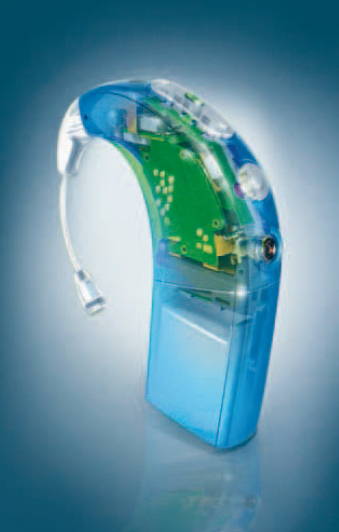
MED-EL announces the Sonnet BTE processor! SONNET features two microphones, enabling directional hearing. New software includes wind noise reduction and automatic volume control.
The processor has one battery option – two zinc-air cells, providing up to 60 hours of battery life. The battery cover accepts 3-pin FM connectors, and also features a direct audio input port.
In addition to a built-in telecoil, a 2.4GHz radio is included for future connectivity options.
SONNET is water-resistant, with an IP54 rating. With only a zinc-air battery option available at the moment, a fully waterproof system seems like it needs to wait for a rechargeable battery option.
Learn more about the SONNET processor!
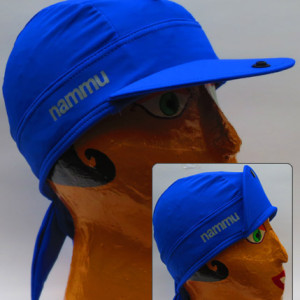 Nammu Hats has just released a new version of the famous Nammu Hat with a sun visor. Now you can clip your a Neptune processor to the hat, or tuck a processor in a waterproof bag beneath it, and be secure in protecting your processor and your vision at the same time!
Here’s how to swim with your processor using a Nammu hat.
And for our readers, enter discount code CochlearImplantHELP when placing an order with Nammu Hats until June 20th to receive a 25% discount!
 Cochlear’s new Aqua+ waterproof sleeve for the Nucleus 5 and Nucleus 6 processors hits the water park just in time for summer! Ben Borhegyi demonstrates how to assemble the Aqua+, and gives us his first impressions and recommendations.
Ben says:
What you get
 Boxes with some Mic Lock-Stirrups, one Aqua+ Coil, a magnet for the coil, and two Aqua+ sleeves.

You also get a safety line, which clips onto your clothing, swim cap, or goggle strap to retain the Aqua+ and your processor if it comes off of your ear.

You can use this waterproof box to store and protect your headpiece and ear hook while you are swimming.
 Sonova, the parent company of Advanced Bionics, reports that AB’s annual growth was over 30% in both Swiss Francs and local currencies. The company says:
“Cochlear implants segment – Drawing from a complete portfolio
The performance of the cochlear implants segment was another highlight in the year under review. The segment achieved sales of CHF 195.3 million, an increase of 33.1% in Swiss francs and 36.0% in local currencies. Supported in particular by the launch of the Naída CI Q70 sound processor in summer 2013, sales accelerated over the course of the year, exceeding a year-on-year growth of 50% in the second half of 2013/14. Europe and North America in particular responded very well to the new sound processor that incorporates many industry-first innovations shared with Phonak hearing aids. The balanced portfolio of electrodes and Advanced Bionics’ swimmable processor also supported growth, which reflected both the addition of new customer clinics and increased penetration at existing accounts. As in the previous year, cochlear implants sales included the fulfillment of a central government tender in China.
Profit from the cochlear implants segment improved strongly during financial year 2013/14, in line with our business plan, despite significant expenses from the launch of new products, particularly the new Naída CI Q70 sound processor. EBITA for the segment reached 12.8 million, representing an operating margin of 6.6%. This is an important step towards our goal of bringing the EBITA margin of the cochlear implants business closer to the corporate average. Normalized for one-off costs, principally the increased product liability provision related to Advanced Bionics’ Vendor B product recall in 2006, the cochlear implants segment had achieved an EBITA of CHF 1.8 million in the previous financial year. In 2013/14 the relevant parameters for the said product liability provision developed fully in line with the assumptions considered in the accounts of the previous financial year. Thus no releases or additions with P&L effect were booked to the provision in the year under review.”
Read the full financial report. Information specific to Advanced Bionics is on pages 26 and 27.
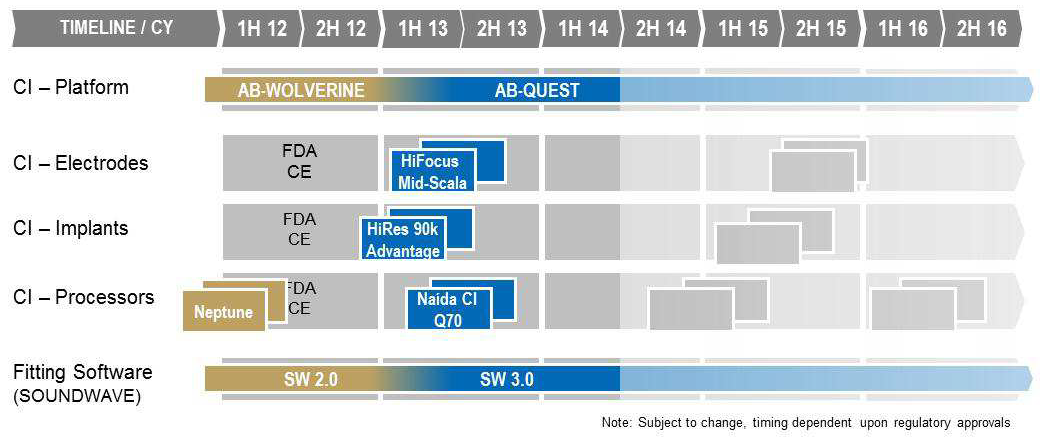
AB also plans to continue the rapid pace of new product introduction. Slide 27 of the investor presentation shows a rough timelines of new electrodes, implants, and processors through fiscal year 2016.
 Advanced Bionics introduces the AquaCase for the Naida CI Q70 processor, just in time for summer!
 cochlear implant HELP